
The standard Golden Triangle itinerary starts in Delhi and ends wherever you can fit Varanasi.
Which is a reasonable approach — Delhi has the international flight connections, and going Delhi → Agra → Jaipur → Delhi is a clean loop. The problem isn't the logic. The problem is the experience. You land in Delhi exhausted from a long-haul flight, transfer to your hotel through traffic that has no precedent in any city you've been to, and are expected to process Old Delhi — Chandni Chowk, the Red Fort, 17th-century Mughal street density — within 24 hours of a 9-hour flight. The Taj Mahal comes on Day 3, when you're still not quite adjusted. Varanasi, if it appears at all, gets bolted on as a flight-connected side trip that feels like a different country at a different pace from a different trip entirely.
The reverse order fixes all of this.
You fly into Varanasi — which receives direct connections from Delhi and has simple, low-pressure arrivals. You start with India's oldest and most spiritually intense city, which sets the tone for everything that follows rather than having to be absorbed in isolation at the end. You take an overnight train west to Agra and arrive at dawn — at exactly the right hour to walk from the station to the Taj Mahal gate before the tour buses, before the day-trippers, before the crowd. You train north to Jaipur, two days of forts and bazaars when you finally understand what you're looking at. You end in Delhi — when you've had 6 days of India, when the city's density is contextualised rather than overwhelming, and when your international departure gate is 45 minutes from the hotel.
Seven days. The same cities. A better sequence.
There is one additional detail about the overnight train to Agra that no standard Golden Triangle guide mentions. The Marudhar Express from Varanasi terminates at Agra Fort station — not Agra Cantt, not New Agra, but the station named for the fort directly adjacent to it. Agra Fort is where Emperor Aurangzeb imprisoned his father Shah Jahan after seizing the Mughal throne in 1658. Shah Jahan spent his final 8 years in the Musamman Burj — the octagonal tower in the fort's northeast corner — watching the Taj Mahal he had built for his wife across 2 kilometres of the Yamuna River. The train from Varanasi deposits you at the station of the fort that imprisoned the man who built the monument you're about to visit. The entire history of the Golden Triangle is compressed into that one arrival.
Sort VisitorsCoverage travel insurance before this trip. The 7-day circuit involves overnight train travel, multiple cities, and the specific logistical intensity of North India. Policies from approximately $18–35 USD. EKTA offers a second comparison option from $0.99/day at ektatraveling.com — worldwide, fully digital, 24/7 support. Compare both before booking anything else.
7-Day Reverse Golden Triangle at a Glance
| Day | Location | Focus |
|---|---|---|
| Day 1 | Fly in → Varanasi | Arrive, Ganga Aarti, ghat evening |
| Day 2 | Varanasi | Dawn boat, Vishwanath Temple, Sarnath |
| Day 3 | Varanasi → Agra (overnight train) | Depart evening, arrive dawn |
| Day 4 | Agra | Taj Mahal at sunrise, Agra Fort, Fatehpur Sikri |
| Day 5 | Agra → Jaipur | Vande Bharat 3.5hrs, Amber Fort afternoon |
| Day 6 | Jaipur | Jantar Mantar, old city, Johari Bazaar |
| Day 7 | Jaipur → Delhi → Depart | Shatabdi 4.5hrs, fly home from DEL |
Getting In: Fly Into Varanasi, Not Delhi
Varanasi's Lal Bahadur Shastri International Airport (VNS) receives direct domestic flights from Delhi (1hr 40min, from ₹2,500/$26.60 USD) and connecting services from Mumbai, Bengaluru, and Kolkata. International visitors arriving from abroad typically route through Delhi — book a same-day connection onward to Varanasi. Search and compare on FlyFlick.
Set a Compensair alert on your Delhi connection — the Delhi-to-Varanasi domestic leg is the most delay-prone part of the trip, particularly in the winter fog season (December–February). EU-connected departure legs from DEL also carry full €600 compensation eligibility.
Activate Saily 5G eSIM before boarding — covers Varanasi, Agra, Jaipur, and Delhi well. Drimsim handles the train-route connectivity gaps in the overnight Varanasi–Agra section.
Book your VNS arrival transfer through GetTransfer or KiwiTaxi — both confirmed for Varanasi airport with fixed-fare pre-booked vehicles. Varanasi airport auto-rickshaws quote variable fares to arriving travellers; a confirmed driver sidesteps this.
Days 1–2: Varanasi — Starting With the Deepest City
Starting in Varanasi recalibrates everything. If you've come to India for the first time, Varanasi tells you immediately that you've arrived somewhere genuinely unlike anything in your previous experience — and gives you 2 full days to begin adjusting to that fact before the circuit moves to the more internationally legible experiences of Agra and Jaipur.
Stay on the ghats. Guesthouses along Assi Ghat and Dashashwamedh Ghat with river-facing windows: ₹1,000–2,500 ($10.64–26.60 USD). Midrange: ₹3,000–6,000 ($31.91–63.83 USD). Book the river-facing room explicitly. The Ganga at dawn through a window is worth every premium.
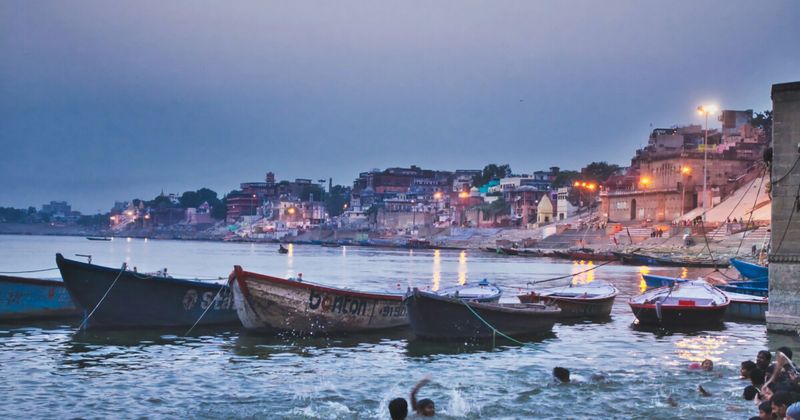
Day 1 evening: Ganga Aarti at Dashashwamedh Ghat. Free. Begins at 6:45pm in winter, 7:15pm in summer. The ceremony — seven priests swinging tiered fire-lamps in synchronised arcs over the river, the crowd packed onto the ghats and in boats on the Ganga — is 45 minutes of concentrated ritual that has been happening every single evening without interruption for centuries. Arrive 30 minutes early for a seated position on the steps. The boats on the river provide the elevated view; negotiate ₹200–400 ($2.13–4.26 USD) per person for a shared boat, ₹1,500–2,500 ($15.96–26.60 USD) for a private one. Pre-book through Klook.
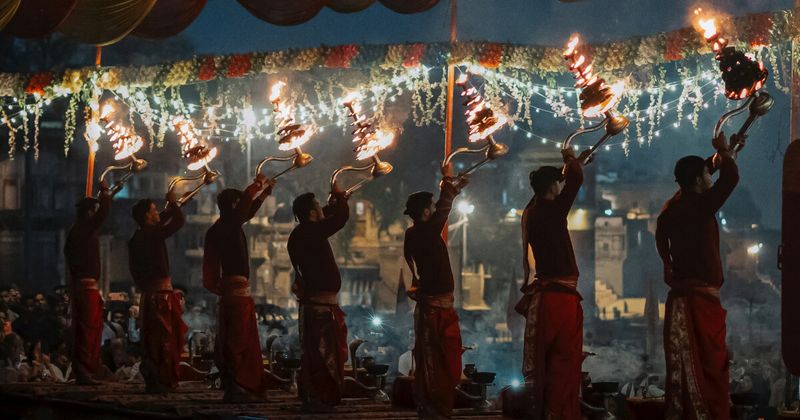
The Ganga Aarti has been performed every evening at Dashashwamedh Ghat without interruption for over 200 years. Dashashwamedh means "ten horse sacrifice" — the ghat where Brahma once performed the ritual.
Don't eat yet. The evening sequence — the aarti, the walk along the illuminated ghats, the gali lanes behind the ghats with their chai stalls and silk shops — takes until 9pm naturally. The kachori sabzi at any stall near the Godowlia crossing (₹30–50 per plate) is the correct Varanasi dinner.
Day 2: The Dawn Boat and Sarnath.
The 5am boat is not optional. A sunrise boat ride on the Ganga from Assi Ghat north past Manikarnika Ghat — the main cremation ghat, where fires have burned continuously for 3,000 years — is an experience with no equivalent in the Golden Triangle circuit or anywhere else in India. Shared boat: ₹200–400 ($2.13–4.26 USD) per person; private: ₹1,000–1,500 ($10.64–15.96 USD). From the water at 5am, the 88 ghats in their pre-dawn grey, the first oil lamps being lit by sadhus on the steps, the smoke from Manikarnika carrying across the river in the still air — this is the image of Varanasi that most visitors carry. Two hours on the river; back at the ghat by 7am.
Kashi Vishwanath Temple: 400 metres from Dashashwamedh Ghat through the gali lanes. Free entry to non-Hindus for darshan from the external corridor; the main sanctum is restricted. The 1780 temple — rebuilt by Ahilyabai Holkar of the Maratha Empire after Aurangzeb destroyed the original — has a golden spire visible above the Old City rooftops. It was most recently renovated as the Kashi Vishwanath Corridor, a massive infrastructure project completed in 2021 that opened the temple precinct to the riverside. Entry involves security screening; no phones inside.
Sarnath: afternoon. 10 kilometres north of Varanasi by auto-rickshaw (₹200–300/$2.13–3.19 USD roundtrip). The Deer Park at Sarnath is where Siddhartha Gautama delivered his first sermon after attaining enlightenment — the beginning of Buddhism as a teaching tradition, approximately 528 BCE. Entry: ₹50 foreigners ($0.53 USD). The Dhamek Stupa (5th–6th century CE, 43 metres high) marks the spot; the Archaeological Museum next door (₹30, closed Fridays) houses the Lion Capital of Ashoka — the 3rd-century BCE sandstone sculpture that became independent India's national emblem and appears on every Indian banknote, passport, and state document. The original, not a replica. In a small museum in Sarnath. Worth 45 minutes of considered looking. Pre-book through Klook.
The full Varanasi guide — Manikarnika, the Kashi Vishwanath Corridor, the Ganga Aarti front-row strategy — is covered in our Varanasi in 3 Days guide if you have more time.
Day 3: The Overnight Train West — Varanasi to Agra
Depart Varanasi evening, arrive Agra at dawn. This is the structural advantage of the reverse route.
Spend Day 3 morning in Varanasi — the Petha sweet shops of the old city, the Ganga at midday with different light, the Ramnagar Fort across the river if your energy allows. Checkout from your guesthouse at noon.
The train: The Marudhar Express (14853/14863/14865) departs Varanasi Junction (BSB) at approximately 16:50 and arrives at Agra Fort (AF) station at approximately 06:35 the following morning — 13 hours 45 minutes. Runs on Monday, Tuesday, Thursday, Friday, and Saturday (check current schedule on 12Go Asia before booking as running days vary by number).
Ticket prices: Sleeper (SL) — ₹365 ($3.88 USD). AC 3-Tier (3A) — ₹990 ($10.53 USD). AC 2-Tier (2A) — ₹1,410 ($15.00 USD). Book on 12Go Asia with your international card — 3–4 weeks ahead for confirmed seats in October–February peak.
Alternative — Vande Bharat (20175): Departs Varanasi 15:20, arrives Agra 22:20 — 7 hours, daytime. CC ₹1,570 ($16.70 USD), EC ₹2,850 ($30.32 USD). The advantage: you arrive in Agra in the evening and have the following morning for the Taj. The disadvantage: you lose a morning in Varanasi and spend an evening in Agra with nothing particular to do. For this circuit, the overnight Marudhar is the correct choice — it saves you an Agra hotel night and puts you at the Taj gate at exactly the right hour.
On the overnight train: The berths in 3A have curtains and bedding is provided. The sound of the train at night moving through the Uttar Pradesh darkness — the stations, the chai vendors at 2am windows, the flat plains — is the most specifically Indian transit experience available and worth the slight discomfort of a sleeping berth over a budget flight. Bring: water, snacks, an eye mask, earplugs.
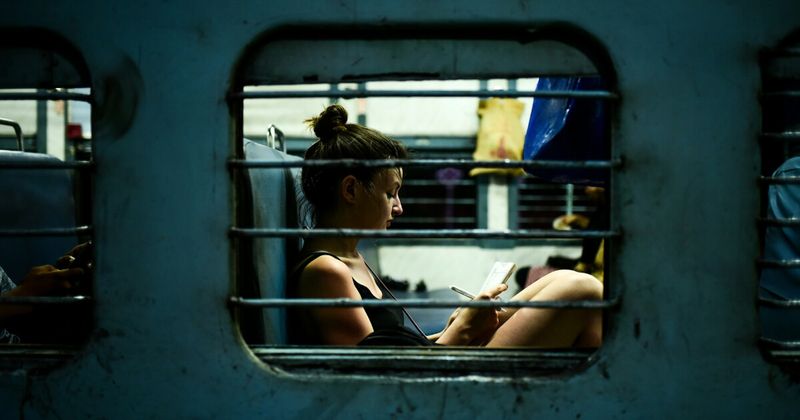
The Varanasi–Agra overnight journey crosses the full breadth of Uttar Pradesh — India's most populous state, 240 million people — passing through Allahabad, Kanpur, and Tundla Junction before dawn.
Why arriving at Agra Fort station matters: The overnight train terminates at Agra Fort station — not Agra Cantonment, which most Agra guides reference. Agra Fort station is immediately adjacent to the Agra Fort monument. The fort is where Emperor Aurangzeb imprisoned Shah Jahan in 1658 after seizing the Mughal throne. Shah Jahan spent 8 years in the Musamman Burj tower of that fort, with a clear sightline to the Taj Mahal across 2 kilometres of the Yamuna River. He died there in 1666, reportedly with his eyes fixed on the marble mausoleum he had built for his wife. You step off the overnight train from Varanasi at the station of the fort that imprisoned the man who built the monument you'll see at sunrise in 90 minutes.
Book your Agra Fort station arrival transfer through KiwiTaxi — confirmed for Agra, fixed fare, meets you at the station exit. Pre-booked with your driver's name and number before you board in Varanasi.
Check Live Flight Prices
Day 4: Agra — The Taj Before the Crowd
Arrive Agra Fort station approximately 6:35am. Your driver meets you at the exit. The Taj Mahal gate is 4 kilometres from Agra Fort station — 15 minutes by vehicle. The Taj opens at sunrise.
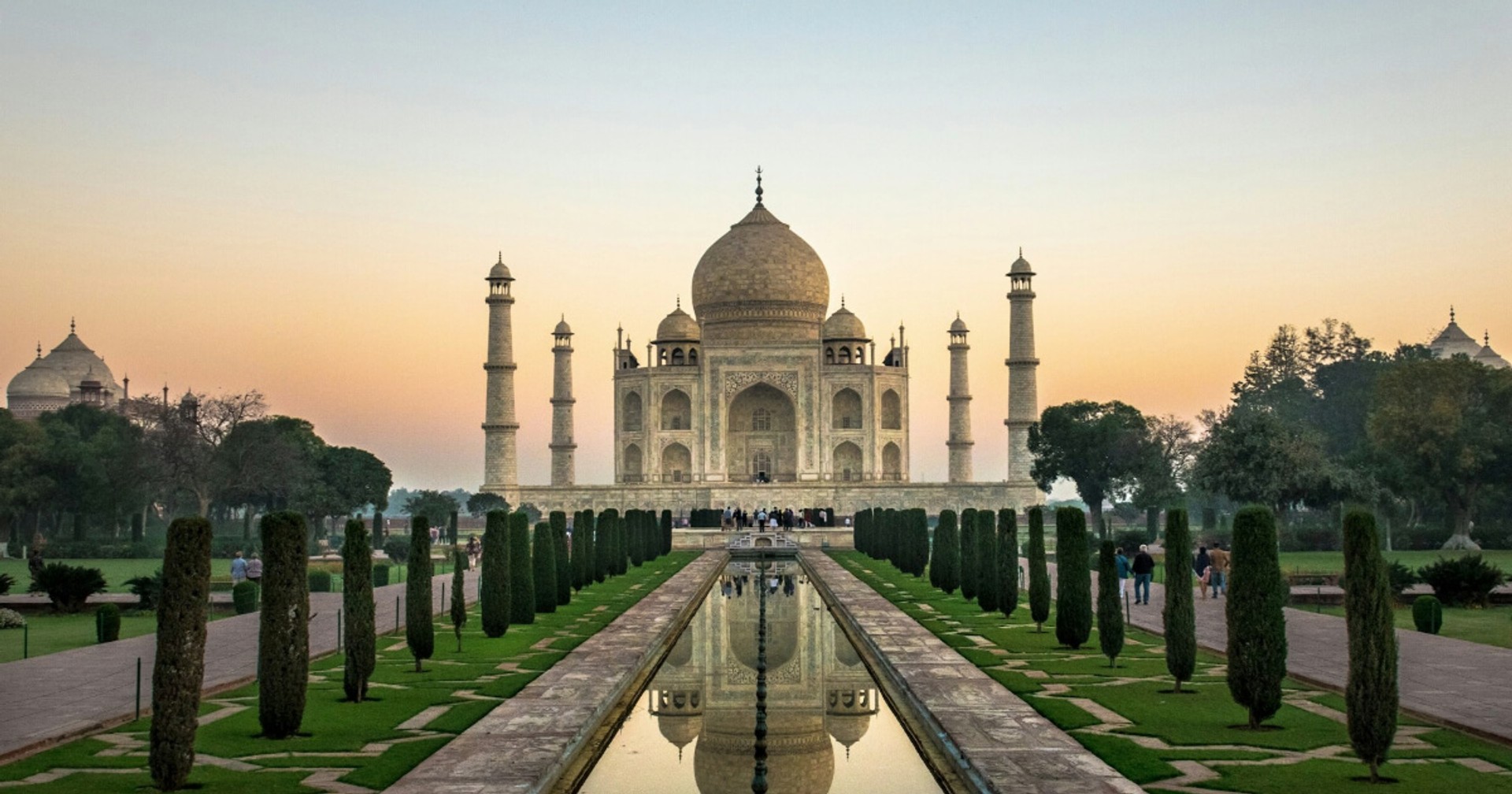
Why this sequence works: The standard Golden Triangle arrives in Agra from Delhi by the 8:10am Gatimaan Express — arriving at 9:50am, when the Taj has been open for 2 hours and the first tours are already inside. The reverse route arrives from Varanasi at 6:35am and has you at the gate for opening. The Taj Mahal in the first 60 minutes of the day, with the mist still on the Yamuna and the garden nearly empty, is a different experience from the Taj at 10:30am. This is not a minor distinction.
Taj Mahal: Entry ₹1,300 foreigners ($13.83 USD) — ₹1,100 monument entry + ₹200 mausoleum interior access. Open at sunrise daily except Fridays. Photography allowed throughout except inside the mausoleum chamber. Book on Klook — advance tickets include the earliest entry slot without counter queues.
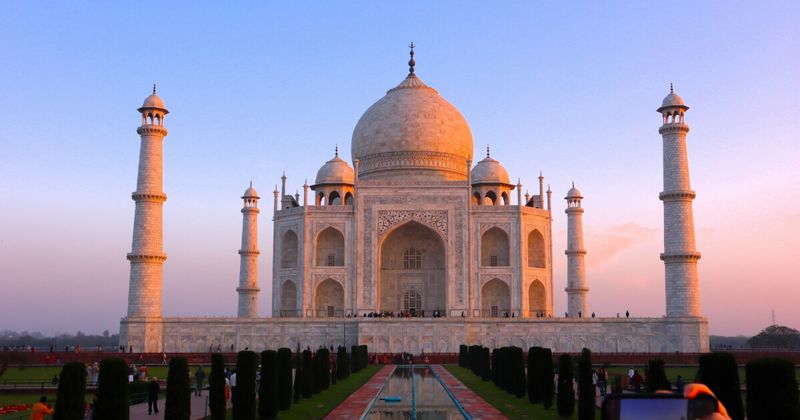
Shah Jahan was imprisoned in Agra Fort for 8 years and died in 1666 with a direct sightline to the Taj across the Yamuna — the overnight train from Varanasi arrives at Agra Fort station, 4km from the Taj gate.
The Taj was built between 1632 and 1653 by Emperor Shah Jahan as a mausoleum for his wife Mumtaz Mahal, who died in childbirth. 20,000 artisans worked for 21 years. The white marble came from Makrana in Rajasthan, 400 kilometres south. The central dome is 73 metres high. The four minarets lean slightly outward — deliberately, so that if any minaret fell, it would fall away from the main tomb. The inlay work on the marble panels uses 28 types of semi-precious stone in 43 designs. It is, in every measurable sense, the most ambitious single structure ever built by one person for another person's memory.
Spend 2 hours. Walk the full garden before approaching the mausoleum. Sit at the central reflecting pool for 15 minutes without photographing anything. Then photograph it.
Agra Fort: 11am. Entry ₹650 foreigners ($6.91 USD). The Musamman Burj tower where Shah Jahan was imprisoned and watched the Taj — 15 minutes from the Taj by auto. From the Burj's octagonal balcony, the Taj Mahal is visible exactly 2 kilometres across the river bend, as Shah Jahan would have seen it daily for 8 years. The sightline is unobstructed. The historical weight of standing on that balcony having just come from the monument across the water is available only if you visit both in the same morning, in this order.
Fatehpur Sikri: afternoon. 40 kilometres southwest of Agra — Emperor Akbar's abandoned capital, built entirely in red sandstone between 1569 and 1585, deserted after just 14 years due to water supply failure. Entry ₹610 foreigners ($6.49 USD). The Buland Darwaza — the great gate, 54 metres high, built to commemorate Akbar's conquest of Gujarat — is the most imposing entrance to any Mughal complex in India, including the Taj. The site is uncrowded relative to Agra. Book transport through Intui.travel for a fixed-fare vehicle for the Agra Fort–Fatehpur Sikri afternoon circuit.
Budget accommodation Agra: ₹1,500–3,000 ($15.96–31.91 USD); midrange: ₹4,000–8,000 ($42.55–85.11 USD).
Day 5: Agra to Jaipur — The Vande Bharat Transition
Agra → Jaipur by train: 3.5–4 hours. Several services run daily — the most comfortable is the SF Express or Vande Bharat on the Agra–Jaipur segment. Book on 12Go Asia, Chair Car from ₹300–800 ($3.19–8.51 USD) depending on service. Depart Agra Cantt (not Agra Fort station — take an auto-rickshaw to Agra Cantt for Jaipur trains, 15 minutes). Alternatively, book the road intercity vehicle via KiwiTaxi for the confirmed Agra→Jaipur fixed-fare route — useful if the train schedule doesn't align with your checkout.
The transition value of doing Jaipur third: By the time you arrive in Jaipur, you have two full days of Varanasi (spiritual and ancient) and one full day of Agra (Mughal and monumental) behind you. Jaipur — the Rajput capital, 18th-century forts, the pink city bazaars — is a third architectural and cultural register. You arrive in Jaipur already knowing how to navigate an Indian city, how to negotiate an auto-rickshaw, how to read a monument complex. The learning curve is finished. Jaipur becomes pleasure rather than orientation.
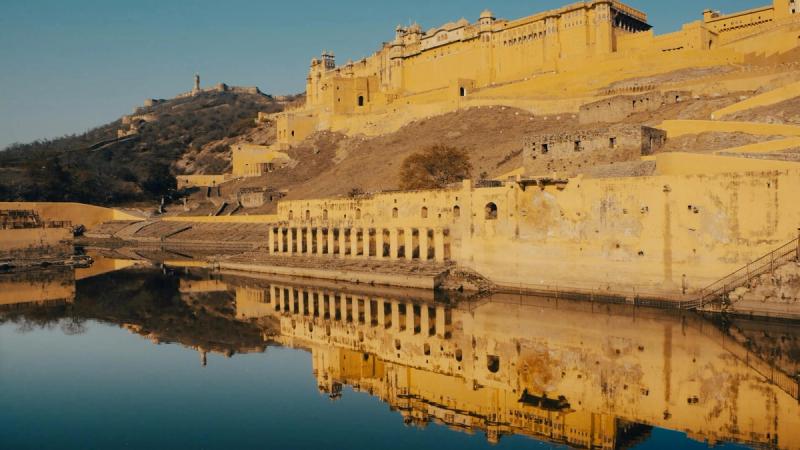
Afternoon: Amber Fort. Entry ₹1,000 foreigners ($10.64 USD). Arrive at 3pm — the afternoon light on the Maota Lake reflection is the best available from the approach road. The Sheesh Mahal (Hall of Mirrors) is the essential interior — 2.5 million pieces of mirror inlay on the ceiling, designed to reflect a single candle into the illusion of a sky full of stars. Pre-book through Klook — skip-the-counter access in peak season (November–February).
The Sheesh Mahal ceiling at Amber Fort uses 2.5 million individual mirror fragments set into plaster — the Maharaja's private audience chamber was designed so a single candle appeared as a sky full of stars.
Budget hotels near Badi Chaupar (old city): ₹800–2,000 ($8.51–21.28 USD). Midrange with haveli character: ₹3,000–7,000 ($31.91–74.47 USD).
Dinner: Laxmi Misthan Bhandar (LMB) on Johri Bazaar — unlimited Rajasthani vegetarian thali including dal baati churma and pyaaz kachori, the best regional food introduction in the city, ₹200–400 ($2.13–4.26 USD) per person.
Day 6: Jaipur — Jantar Mantar, the Old City and What to Skip
The Jaipur Composite Ticket: ₹1,500 foreigners ($15.96 USD) — covers Amber Fort, Jantar Mantar, Hawa Mahal, Albert Hall Museum, and three additional sites over two consecutive days. If you visited Amber yesterday with a separate ticket, the composite ticket covers today's Jantar Mantar and Hawa Mahal plus the remaining sites. Buy at any of the covered monuments.
Jantar Mantar: 9am. Entry covered by composite ticket or ₹200 standalone ($2.13 USD). The 18th-century astronomical observatory built by Maharaja Jai Singh II in 1734 contains 19 instruments — all working, all accurate within 2 seconds per day. The Samrat Yantra is a 27-metre sundial that casts a shadow moving at 1mm per second — the shadow's leading edge is a measurable timepiece. The instruments are made of masonry and marble, not metal, which eliminated the thermal expansion that made earlier metal instruments unreliable. Jai Singh built five such observatories across India; Jaipur is the largest, best-preserved, and most comprehensible for the non-specialist. Pre-book through Klook.
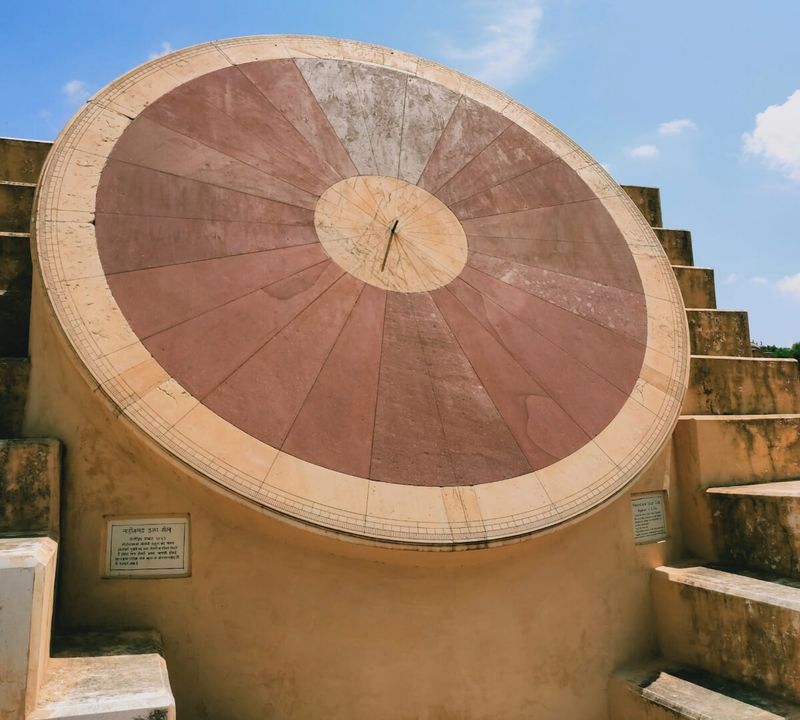
Maharaja Jai Singh II built Jantar Mantar in 1734 using masonry instead of metal because thermal expansion made metal instruments unreliable — the solution produced instruments still accurate after 290 years.
Hawa Mahal: 11am. Entry ₹200 foreigners ($2.13 USD). The five-storey façade of 953 latticed windows was built in 1799 to allow the women of the royal court to observe street life without being seen. It is best photographed from the rooftop of the café directly opposite on Sirideori Bazaar Road — the full facade visible from that angle at 4–5pm light.
Johri Bazaar afternoon. The jewellery market of Jaipur — silver, semi-precious stones, lac bangles, block-printed textiles. Prices are lower than equivalent pieces in Delhi's tourist markets. The silver work is particularly good value: necklaces, earrings, and rings in the Rajasthani style from ₹200–2,000 ($2.13–21.28 USD) depending on weight. Negotiate — the initial price is always 20–30% higher than the acceptable one.
What to skip today: City Palace (₹700 foreigners) is excellent but competes with Jantar Mantar and Hawa Mahal for time. Skip it or include it only if you've seen Amber Fort fully and have energy remaining after the bazaar. Nahargarh Fort (₹200) at sunset is worth adding if you have a vehicle — the view over Jaipur at dusk from the hill above the city is excellent.
Book a Day 6 full-day vehicle through Intui.travel for the Jantar Mantar → Hawa Mahal → Johri Bazaar → Nahargarh circuit.
Day 7: Jaipur to Delhi — Arriving Prepared
The Shatabdi advantage of arriving last in Delhi: When you arrive in Delhi for the first time on Day 1 of a Golden Triangle itinerary, you face a city of 33 million people with no context for navigating it. When you arrive on Day 7, having been in Varanasi's gali lanes and Agra's monument zones and Jaipur's bazaars, Delhi is simply another Indian city. You know how the auto system works. You know how the ticketing works. You know what your options are. Delhi's density is still Delhi's density, but it's contextualised rather than overwhelming.
Jaipur → Delhi by Shatabdi: 4.5 hours. The Pink City Shatabdi departs Jaipur Junction at approximately 5:50am, arriving New Delhi at approximately 10:40am. Chair Car from ₹650–850 ($6.91–9.04 USD). Book on 12Go Asia. Alternatively, several faster express services run through the day. On the morning Shatabdi, breakfast is included.
Delhi half-day before departure: The morning Shatabdi arrival in Delhi gives you 5–6 hours before an evening international flight. The practical use:
Humayun's Tomb: 11am. Entry ₹600 foreigners ($6.38 USD). 15 minutes from New Delhi station by auto. The 1562 Mughal garden-tomb that was the direct architectural prototype for the Taj Mahal — built 70 years earlier, the same Persian garden-tomb formula, the same white marble and red sandstone combination, the same central dome. After 4 days of Golden Triangle Mughal architecture, Humayun's Tomb closes the loop: you began in Varanasi, where the Mughal Empire imprisoned its dissidents and executed its enemies; you end at the tomb that invented the architectural tradition Shah Jahan perfected. Pre-book through Klook for the combined Humayun's Tomb + Qutub Minar ticket if you have time for both.
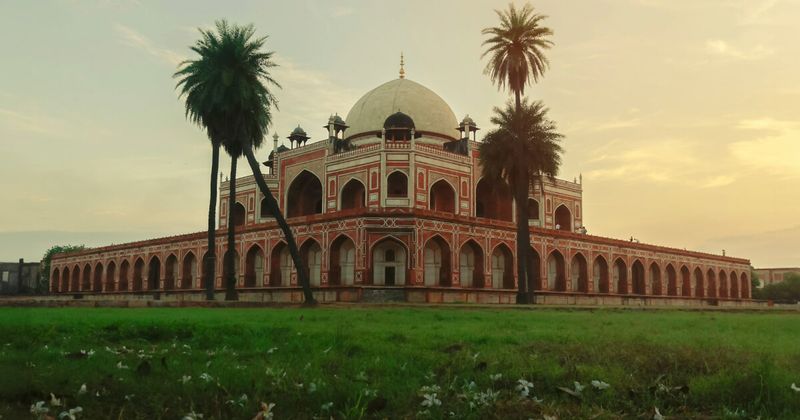
Humayun's Tomb was built 70 years before the Taj and established the architectural formula Shah Jahan refined — Persian garden-tomb design, central dome, white marble on red sandstone, charbagh water channels.
Delhi airport transfer: 3pm. DEL is 18 kilometres from the tomb and 35 kilometres from Connaught Place — allow 60–90 minutes in Delhi traffic. Book through GetTransfer for a pre-confirmed fixed-fare vehicle from Humayun's Tomb directly to Terminal 3 (international departures). Pre-book this the night before in Jaipur — arrival-day Delhi airport booking adds unnecessary stress.
Our full Delhi in 3 Days guide covers the city in depth if you're adding a night before departure.
Why the Reverse Route Beats the Standard Order
This is the argument in explicit form, for anyone still deciding.
The standard route's problem: Delhi first means absorbing the most complex city at the beginning of the trip when you're least adapted. Varanasi last (if it appears at all) means experiencing the most spiritually and historically intense place in India when you're most tired. The Taj Mahal on Day 3 arrives when you're still adjusting to the country.
The reverse route's advantages:
Varanasi at maximum openness. The Ganga Aarti, the dawn boat, the burning ghat — these require a specific quality of receptiveness that you have on Day 1 and significantly less of on Day 6. Start where the experience is hardest to process and give yourself maximum time to process it.
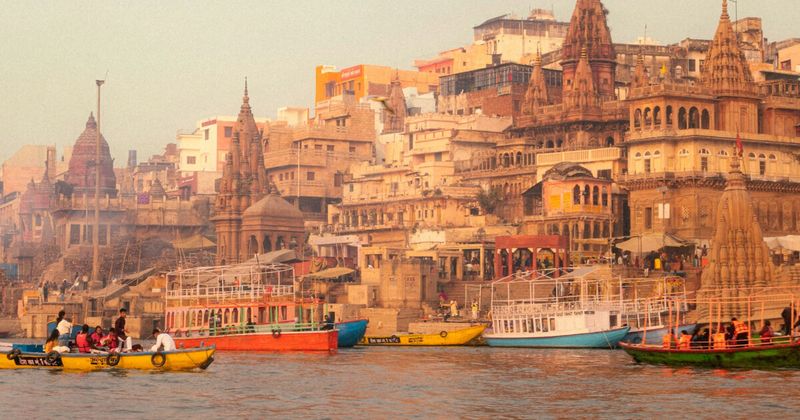
The 84 ghats of Varanasi stretch 6.5 kilometres along the Ganga's western bank; the number 84 represents the 8.4 million species through which the Hindu soul transmigrates before human birth.
Agra at the perfect hour. The overnight train deposits you at the Taj gate at sunrise. This is not achievable from the standard Delhi approach without booking a specific early Shatabdi and losing Varanasi from the circuit entirely.
Delhi at maximum competence. By Day 7, you know how to read an auto-rickshaw queue, how to navigate a monument complex, and how to handle an Indian city at scale. Delhi's density is the same either way — your ability to navigate it is categorically different on Day 7 versus Day 1.
The emotional arc works. The standard route moves from monument to monument in roughly equivalent registers. The reverse route moves from spiritual depth (Varanasi) to aesthetic peak (Taj Mahal) to architectural density (Jaipur) to urban scale (Delhi) — a sequence with genuine momentum.
Pace and Burnout: What This Circuit Demands
The overnight train is the biggest ask. Most travellers not accustomed to Indian overnight trains find the 13-hour sleeper berth more demanding than expected. The berths are functional but not plush — earplugs are necessary, the AC in 3A is genuinely cold in winter (bring a light layer), and the train will stop at stations through the night. This is manageable and, for most travellers, memorable rather than exhausting. But it should not be the first Indian overnight train for someone who is already sleep-deprived.
Build in the Day 4 Agra rest. Arriving at 6:35am and going straight to the Taj is the right call. But build the afternoon in Agra — the Agra Fort and Fatehpur Sikri — at a slightly reduced pace. Don't attempt three major monuments on the same day you arrive from an overnight train. Two, with a midday hour at the hotel, is correct.
The Jaipur second-day slowdown is intentional. Day 6 is Jaipur's exploratory day — Jantar Mantar, the bazaar, an unscheduled afternoon. Resist the urge to fill it entirely. The Day 7 Shatabdi departs before 6am (check current schedules); an early night in Jaipur on Day 6 is not a luxury, it's a logistical requirement.
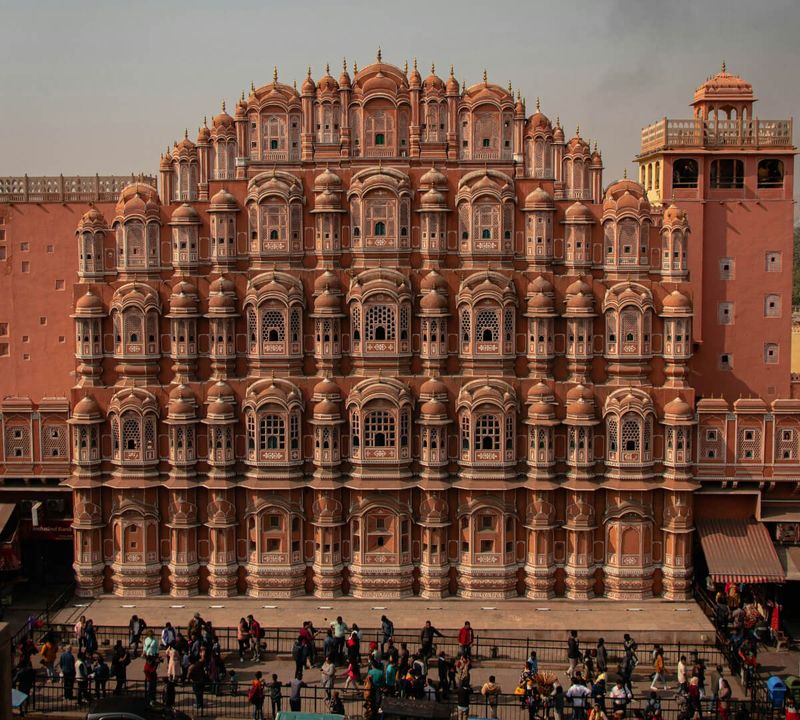
The Hawa Mahal was built in 1799 so the royal court women could observe street festivals while remaining behind the latticed screens — the facade faces east for morning light on the windows.
Best season: October–March. November–February is peak — book the overnight Marudhar Express 4–6 weeks ahead, Amber Fort skip-the-counter tickets 1 week ahead, and Taj sunrise slots 48–72 hours ahead. March is good light and thinning crowds.
7-Day Budget Breakdown
| Expense | Budget | Mid-Range |
|---|---|---|
| Flights (return via VNS + DEL) | Search FlyFlick | varies |
| VNS airport transfer | ₹300–500 ($3.19–5.32) auto | ₹800–1,200 GetTransfer/KiwiTaxi |
| Varanasi accommodation (2 nights) | ₹1,000–2,500 ($10.64–26.60)/night | ₹3,000–6,000 ($31.91–63.83)/night |
| Ganga boat rides (x2) | ₹400–800 ($4.26–8.51) total | ₹1,500–3,000 ($15.96–31.91) private |
| Ganga Aarti boat seat | ₹200–400 ($2.13–4.26) | ₹1,500–2,500 ($15.96–26.60) private |
| Sarnath | ₹50 ($0.53) | ₹80 ($0.85) + museum |
| Overnight train Varanasi → Agra | ₹365 ($3.88) Sleeper | ₹990 ($10.53) 3AC |
| Agra accommodation (1 night) | ₹1,500–3,000 ($15.96–31.91)/night | ₹4,000–8,000 ($42.55–85.11)/night |
| Taj Mahal (foreigners) | ₹1,300 ($13.83) | ₹1,300 + Klook guide |
| Agra Fort | ₹650 ($6.91) | ₹650 ($6.91) |
| Fatehpur Sikri | ₹610 ($6.49) | ₹610 + vehicle Intui.travel |
| Agra → Jaipur train/vehicle | ₹300–500 ($3.19–5.32) train | ₹2,500–3,500 KiwiTaxi road |
| Jaipur accommodation (2 nights) | ₹800–2,000 ($8.51–21.28)/night | ₹3,000–7,000 ($31.91–74.47)/night |
| Amber Fort | ₹1,000 ($10.64) | ₹1,500 ($15.96) composite ticket |
| Jantar Mantar + Hawa Mahal | ₹400 ($4.26) | ₹1,500 ($15.96) composite |
| Jaipur → Delhi Shatabdi | ₹650–850 ($6.91–9.04) CC | ₹1,200–1,500 ($12.77–15.96) EC |
| Humayun's Tomb Delhi | ₹600 ($6.38) | ₹600 ($6.38) |
| DEL airport transfer | ₹600–800 ($6.38–8.51) | ₹1,500–2,500 GetTransfer |
| Food (7 days) | ₹400–700 ($4.26–7.45)/day | ₹1,000–2,500 ($10.64–26.60)/day |
| Travel insurance | VisitorsCoverage/EKTA from ~$18 | from ~$18 |
| 7-day total per person (excl. int'l flights) | ₹18,000–28,000 ($191–$298) | ₹50,000–80,000 ($532–$851) |
All prices INR. USD at ₹94 = $1. INR prices are reliable; USD approximate.
Check Live Flight Prices
The Bottom Line
The Golden Triangle done backwards is not a contrarian position. It's a logistical argument that produces a better sequence of experiences in the same number of days.
Start in Varanasi — where the Ganga Aarti tells you immediately that you've arrived somewhere that operates on different logic from anywhere you've been. Take the overnight train west and emerge at Agra Fort station at dawn, carrying the knowledge that the man imprisoned in that fort built the monument 2 kilometres across the river. See the Taj in the first hour. Move to Jaipur when you know how India works. Arrive in Delhi when you're ready for it.
Seven days. The same four cities. The order that earns every one of them.
Your Reverse Golden Triangle Checklist
🛡️ Travel Insurance — First, Always: VisitorsCoverage — Overnight trains and multi-city transit need minimum $100K USD medical; from ~$18–35 USD | EKTA — Second option from $0.99/day at ektatraveling.com; 24/7 multilingual support. Compare both.
✈️ Flights & Delay Protection: FlyFlick — Fly into Varanasi (VNS) via Delhi; open-jaw out of Delhi (DEL) saves backtracking | Compensair — Claim up to €600 for delayed/cancelled flights; Delhi winter fog disrupts the Delhi–Varanasi domestic connection.
🚂 Trains — Book 3–4 Weeks Ahead: 12Go Asia — Marudhar Express (14853) Varanasi BSB → Agra Fort AF; departs ~16:50, arrives ~06:35; Sleeper ₹365, 3AC ₹990. Jaipur → Delhi Pink City Shatabdi (12036) departs ~05:50, arrives 10:40; CC from ₹650. Book all legs simultaneously.
🚖 Transfers: GetTransfer — VNS airport arrival; DEL airport departure | KiwiTaxi — Agra Fort station arrival pick-up; Agra → Jaipur road | Intui.travel — Agra Fort + Fatehpur Sikri full-day vehicle; Jaipur Day 6 circuit.
🎟️ Experiences to Pre-Book: Klook — Ganga Aarti front-row boat ₹200–₄00; Sarnath Lion Capital museum; Taj Mahal sunrise entry ₹1,300 (book 48–72hrs ahead peak season); Amber Fort ₹1,000 skip-the-counter; Jantar Mantar.
📱 Connectivity: Saily — 5G eSIM; Varanasi, Agra, Jaipur, Delhi all covered | Drimsim — Off-grid backup; useful for the overnight Varanasi–Agra train journey.
Varanasi first. Delhi last. The order earns everything in between.