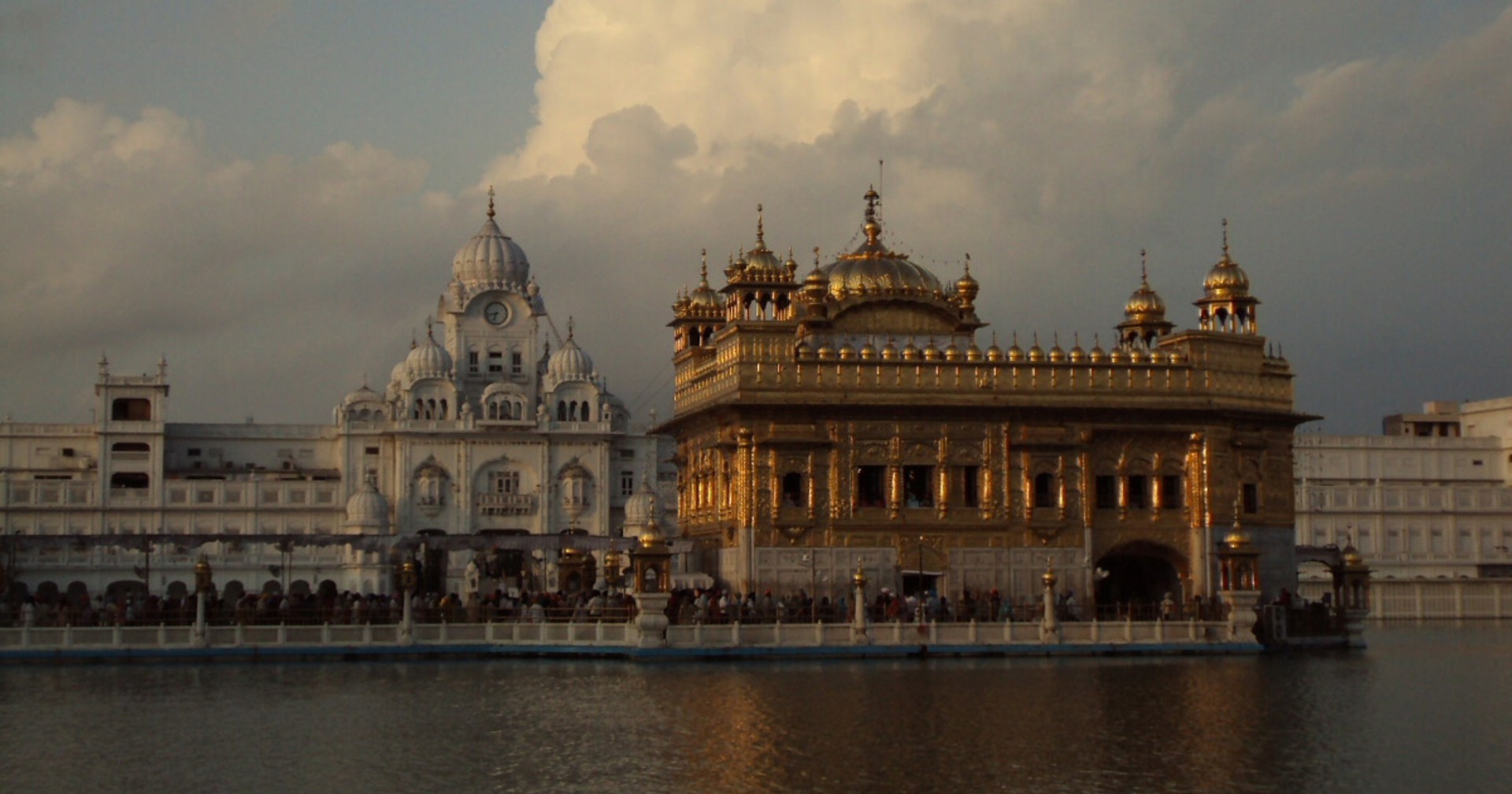

The foundation stone of the Golden Temple — the holiest shrine of Sikhism, visited by more people every year than the Taj Mahal — was laid in 1589 by a Muslim man.
Mian Mir was a Sufi saint from Lahore, one of the most revered spiritual figures in Punjab at the time. Guru Arjan Dev, the fifth Sikh guru, invited him specifically to lay the foundation stone of Harmandir Sahib — not a Sikh holy man, not a Hindu priest, not a figure from any tradition that would mirror his own. A Muslim Sufi. The choice was deliberate and, in its specific 16th-century political context, radical: at a time when religious identity determined social survival, the fifth Guru entrusted the most sacred moment of his faith's most sacred building to someone from a different faith.
This is also why the temple was built lower than the surrounding land. Not elevated above the visitor on a plinth like every other important religious structure of the era, but sunk below the marble parikrama walkway, so that every visitor must descend to reach it — an act of physical humility encoded in the architecture. The four equal entrances facing the four cardinal directions — not one grand entrance, not a hierarchy of gates — mean that from any direction, from any community, you arrive at the same door.
The langar kitchen, running 24 hours a day, 365 days a year, feeds somewhere between 50,000 and 100,000 people every single day without charge, without discrimination, without asking a single question about who you are.
Two days in Amritsar does something to your understanding of India that three weeks in Rajasthan cannot replicate. Not because Rajasthan isn't extraordinary — it is — but because Amritsar engages a different register entirely. The Taj Mahal is the most beautiful thing a dynasty built for itself. The Golden Temple is the most beautiful thing a community built for everyone.
Sort VisitorsCoverage travel insurance before this trip. Amritsar is domestically accessible but the travel context — train from Delhi, winter cold, outdoor ceremony — merits proper cover. Policies from approximately $12–20 USD for a short Punjab trip. EKTA offers a second comparison option from $0.99/day at ektatraveling.com. Compare both.
2-Day Amritsar at a Glance
| Day | Focus | Key Experiences |
|---|---|---|
| Day 1 | History, spiritual depth, food | Golden Temple dawn, Jallianwala Bagh, Partition Museum, old city kulcha and bazaars |
| Day 2 | Sunrise return + border | Golden Temple at sunrise, Wagah Border Beating Retreat ceremony |
Getting to Amritsar
Amritsar is 450 kilometres from Delhi — 6–8 hours by the best trains, 1 hour by air. The correct choice for most international travellers combining Amritsar with a broader North India circuit is the train.
By train from Delhi: The Swarna Shatabdi (12029) departs New Delhi at 7:20am, arrives Amritsar at approximately 1:30pm — 6 hours 10 minutes, Chair Car from ₹900–₁,200 ($9.57–₁2.77 USD). The Vande Bharat Express is the fastest at approximately 5.5 hours. Book on 12Go Asia with your international card — 2–3 weeks ahead in peak season (November–February). The Shatabdi includes a complimentary breakfast and tea/coffee service; the journey passes through the Punjab plains with views of wheat fields, canal systems, and the agricultural infrastructure of India's breadbasket state.
By air: Amritsar's Sri Guru Ram Dass Jee International Airport (ATQ) receives flights from Delhi (1 hour, from ₹2,500–₅,000/$26.60–₅3.19 USD) and direct international connections from several Gulf cities and Birmingham, UK. Search and book on FlyFlick. Set a Compensair alert — small regional airports and EU-connected return legs are both worth protecting.
Book your Amritsar railway station or airport arrival transfer through GetTransfer or KiwiTaxi — both confirmed for Amritsar transfers. Amritsar city is compact; the Golden Temple is less than 2 kilometres from the railway station and tuk-tuks and auto-rickshaws cover the city efficiently at ₹50–₁50 ($0.53–₁.60 USD) per ride.
Activate Saily 5G eSIM before arriving — excellent coverage throughout Amritsar city. Note: mobile signal completely disappears near the Wagah Border due to military signal jammers. Download offline maps for the Day 2 border area before leaving your hotel.
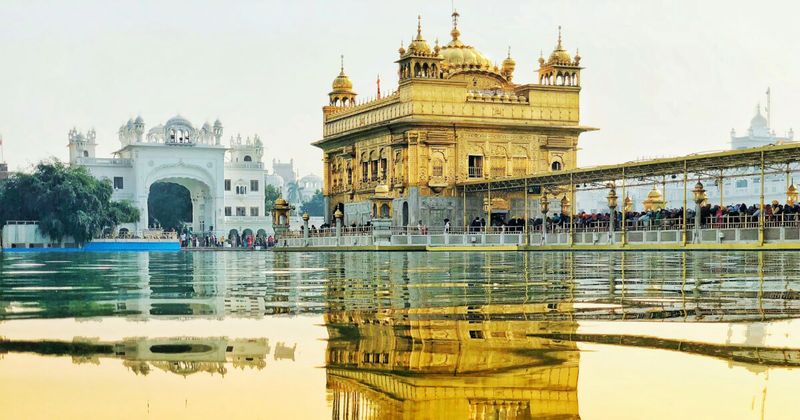
The gold covering on Harmandir Sahib's upper structure represents approximately 750 kg of pure gold applied in panels under the patronage of Maharaja Ranjit Singh in 1830 — the same maharaja who consolidated the Sikh Empire across Punjab and Afghanistan and whose court in Lahore was described by European visitors as more magnificent than anything they had seen in contemporary Europe; the gold panels have been refurbished and added to multiple times since, with the most recent restoration completed in the 1990s.
Day 1: The Temple, the Massacre, the Museum
The Golden Temple: 4am
Set your alarm. This is the single most important timing decision in any Amritsar visit. The Golden Temple at 4am — the pre-dawn hour when the first prayers begin — is a completely different place from the Golden Temple at 10am or 2pm. The marble parikrama is near-empty. The reflection of the lit shrine in the Amrit Sarovar is perfect, the water completely still, the double image of gold above and below looking like a tear in the fabric between sky and water. Gurbani — the continuous recitation of sacred scripture — drifts across the tank from the central shrine, carried on the morning air. The temperature in winter (November–February) is 3–12°C: bring a layer.
Entry rules for the Golden Temple: No entry fee, ever, for anyone. Head must be covered — scarves are available free at all entrances if you don't have one. Shoes removed and deposited at the jorha ghar (shoe counter) at the entrance, free. Wash your feet in the foot pool at the entrance — follow the other visitors. Modest dress: no shorts, no sleeveless. Photography allowed throughout the complex except inside the sanctum itself during prayer. This is not a tourist attraction that happens to also be a religious site; it is a religious site that also receives tourists. The difference matters in how you move through the space.
The structure: The marble walkway (parikrama) circles the entire Amrit Sarovar — a 2-kilometre perimeter walk around the sacred tank. The central shrine is connected to the walkway by the Guru's Bridge, a causeway across the water. The queue to enter the central shrine forms on the parikrama and moves at the pace of darshan — the sacred viewing of the Guru Granth Sahib, the holy book of Sikhism, which is housed and continuously read aloud inside. You join the queue, walk the causeway, enter the sanctum, receive the experience — the kirtan (devotional music), the gold inlay walls, the sacred book attended by priests — and exit from the other side. Don't rush the queue. Don't push. The queue takes approximately 30–90 minutes depending on the hour.
Akal Takht: The building directly opposite the causeway entrance — the Akal Takht (Throne of the Timeless One) is the temporal seat of Sikh political authority, built by Guru Hargobind in 1606. In 1984, Indian Army tanks destroyed it during Operation Blue Star — the Indian government's military assault on armed militants who had taken refuge in the temple complex under Jarnail Singh Bhindranwale. The Akal Takht was rebuilt by the Sikh community immediately after 1984 and again extensively in the 1990s. The trauma of Operation Blue Star — the army entering the holiest Sikh shrine, hundreds of pilgrims killed — is present in Amritsar's living memory in a way that requires acknowledgement. It led directly to the assassination of Prime Minister Indira Gandhi four months later, by her own Sikh bodyguards. These are not ancient events.
Allow a minimum of 2–3 hours at dawn. Many visitors spend 4–5 hours without noticing.
Langar: eat before you leave.
The langar hall is adjacent to the main complex. You queue, receive a steel tray and bowl, sit cross-legged in a row on the floor (this is called pangat — the row), and volunteers move through with large pots filling your tray with dal, sabzi (vegetable curry), chapati, and kheer (rice pudding) on certain days. Everything is refilled without asking. When you finish, you wash your own tray in the washing area and deposit it before leaving. The entire experience — sitting on a floor, eating the same food as the person beside you who may have come from a different country, religion, or station in life — is one of the most equalising 30 minutes available to a visitor anywhere in India.
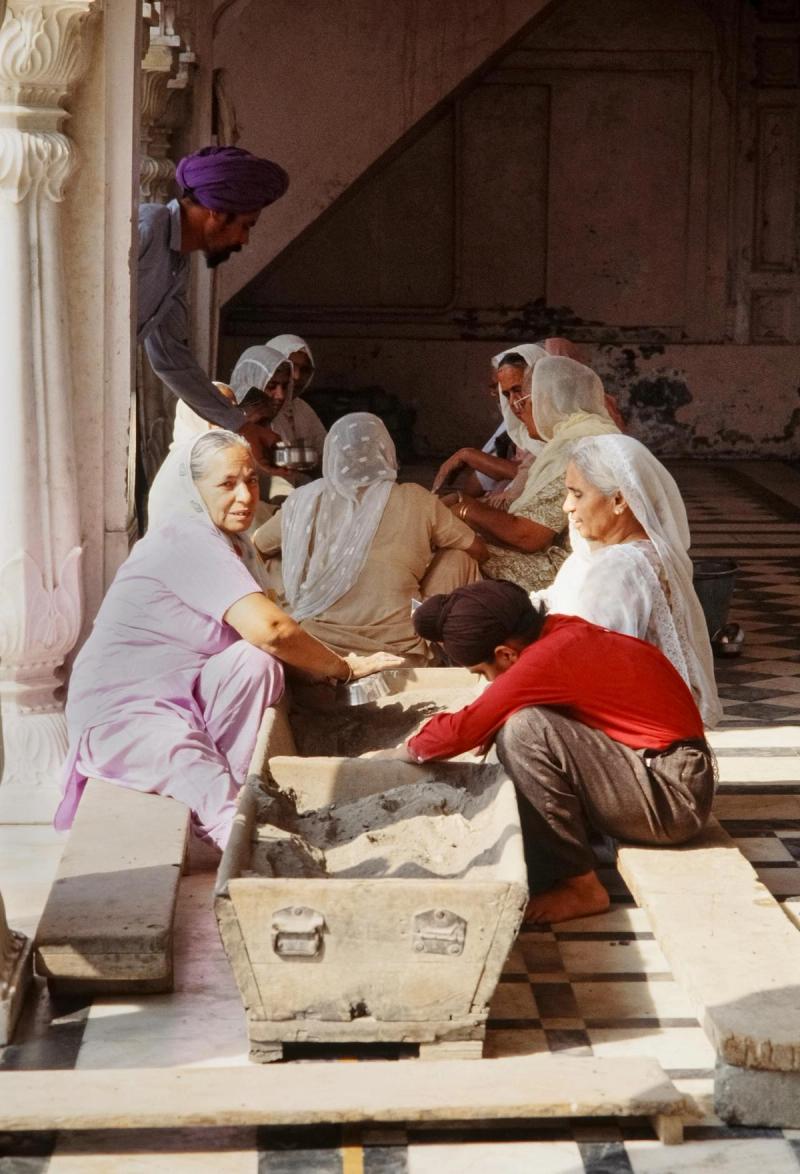
The langar operates on an economy of sewa — selfless voluntary service — with an estimated 50,000 volunteers contributing daily labour without payment; the kitchen consumes approximately 12,000 kg of flour, 1,500 kg of rice, and 1,000 kg of lentils per day at its peak, all donated through a system of community contributions that has sustained the kitchen continuously since it was established by Guru Nanak, the first Sikh Guru, in the 15th century.
Amritsari Kulcha: 9am
Leave the temple complex and walk north through the Heritage Street bazaar toward Katra Jaimal Singh. The Amritsari kulcha breakfast is not optional.
The kulcha is the defining food of Amritsar: a leavened bread stuffed with spiced potato and sometimes cauliflower and paneer, baked against the walls of a tandoor oven (not on the floor, against the wall — the direct clay contact creates a different crust), served with thick white butter, a dense spiced chickpea chole, pickle, and raw onion. The combination of textures — the soft interior, the charred exterior, the creamy chole, the sharp onion — has no equivalent in the rest of India, where "kulcha" refers to a different bread entirely.
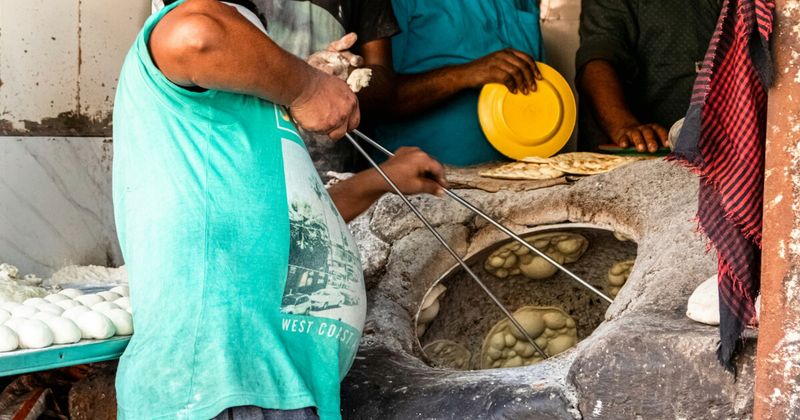
The tandoor in which Amritsari kulcha is baked operates at approximately 480°C — nearly twice the temperature of a domestic oven — which is why the exterior of the kulcha chars and blisters in under 3 minutes while the interior remains soft; the technique of pressing dough against the vertical clay wall rather than placing it on the floor is specific to the North Indian tandoor tradition and produces a flake at the bread surface that cannot be achieved by any other method.
Kulwant Singh's All India Famous Amritsari Kulcha at Katra Jaimal Singh is the most celebrated address — ₹40–80 ($0.43–0.85 USD) per kulcha — but the queue forms early and the shop closes when the day's dough runs out, typically by noon and sometimes before 11am on weekends. Arrive before 9:30am for the least waiting. Kulcha Land at Majitha Road is the alternative if Kulwant Singh's is sold — same quality, slightly less famous. All kulcha shops in Amritsar close by 3pm.
Wash it down with a Amritsari lassi — full-fat buffalo milk yoghurt whipped with cream and topped with a layer of malai (clotted cream) and sometimes a sprinkle of saffron. ₹50–80 ($0.53–0.85 USD) per glass, available at dhaba counters throughout the old city. The density of a glass of Amritsari lassi, if you are unused to it, is approximately that of a light meal.
Jallianwala Bagh: 11am
A 5-minute walk from the Heritage Street entrance of the Golden Temple complex. Entry: free. Open from approximately 6am to 10pm.
On April 13, 1919 — the festival of Baisakhi — several thousand people gathered in this walled garden for a peaceful public meeting. Some were attending a protest against the British Rowlatt Act; many more were simply pilgrims in Amritsar for the festival who had wandered into the park. Brigadier-General Reginald Dyer arrived with 50 Gurkha and Baluchi soldiers and two armoured cars mounted with machine guns. The cars couldn't enter through the single narrow entrance. He ordered 50 soldiers to fire without warning into the crowd for 10–15 minutes. They fired 1,650 rounds of .303 ammunition. The garden has only one exit — the same narrow lane where the soldiers stood. People ran for the walls; the walls are 3 metres high. The Martyrs' Well — a 15-metre-deep open well in the northeast corner — contains the bodies of those who jumped to escape the bullets and were crushed by the people jumping after them. The British government's official count: 379 dead. The Indian National Congress investigation: 1,000 dead. The actual number has never been established.
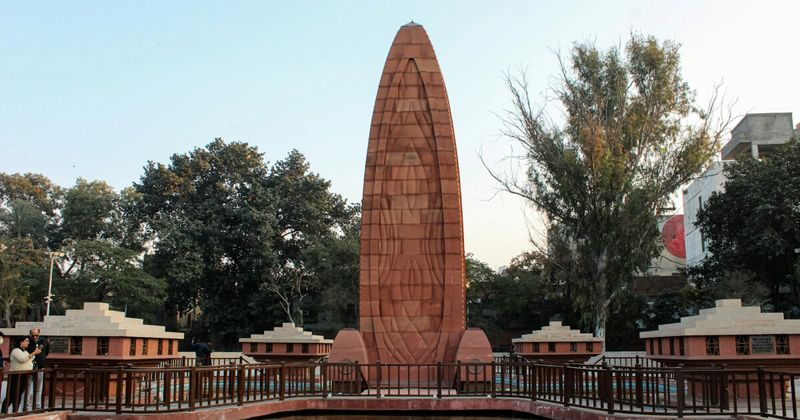
The Jallianwala Bagh massacre had a direct and documented effect on Rabindranath Tagore — India's Nobel Prize-winning poet and the composer of Jana Gana Mana, the Indian national anthem — who returned his knighthood to the British government in protest: "I wish to stand, shorn of all special distinctions, by the side of those of my countrymen who, for their so-called insignificance, are liable to suffer a degradation not fit for human beings."
Dyer was removed from command by the British government in 1920 but faced no criminal charges. The Hunter Commission report condemned his actions. He returned to England and was celebrated by sections of the British press and public as a hero of empire. He died of a stroke in 1927. The bullet holes remain in the brickwork of the garden walls. They are not painted over. They are not filled. They have been left exactly as they were because the SGPC — the body that manages Sikh religious sites — understands that the most powerful memorial is the material evidence itself.
Spend 45 minutes minimum. The gallery of photographs and documents at the entrance is worth reading in full. The well has a glass covering now; look down. The walls are worth examining at close range. The garden is more affecting in quiet contemplation than in a guided tour.
Partition Museum: 1pm
On Heritage Street, 1 kilometre from Jallianwala Bagh, in the historic 1870 Town Hall building. Entry: ₹250 for foreigners ($2.66 USD); ₹10 for Indians. Open 10am–6pm, closed Mondays.
The world's first museum dedicated to the 1947 Partition of British India — the event that created India and Pakistan simultaneously and displaced between 10 and 20 million people, producing the largest mass migration in recorded human history. The museum holds oral histories, refugee artefacts (a traditional rope cot carried across the border, personal photographs of families that were never reunited, an antique pocket watch from someone killed in the violence), newspaper clippings from August 1947, and the Gallery of Hope — testimonies from Partition survivors about what they found after crossing.
The museum was opened on August 17, 2017 — 70 years to the day after the actual India-Pakistan boundary was announced. The boundary announcement came two days after the official Partition date of August 15, 1947: the British left before the lines were finalised, and millions of people woke up in countries they hadn't chosen after the announcement arrived. This specific failure of administrative sequencing — the British left, then told people which country they were in — produced much of the subsequent violence.
Photography is not permitted inside. Allow 1 hour. It is, for many visitors, the most emotionally demanding 60 minutes of any India trip. Book a guided museum tour through Klook for deeper contextual narration.
Dinner: Kesar da Dhaba. Established in 1916 in the Chowk Passian area — an institution of the pre-Partition Punjab that somehow survived all of it. Thali: dal makhani, sabzi, roti, rice, ₹150–250 ($1.60–2.66 USD). The dal makhani here is black lentils slow-cooked with cream and butter for upward of 8 hours — nothing you can order at an "Indian restaurant" in any other country comes close to the original. Cost for two: approximately ₹500 ($5.32 USD).
Check Live Flight Prices
Day 2: Golden Temple at Sunrise and Wagah Border at Sunset
Day 2 is structured around two moments of ceremony — one spiritual, one military — both at the edges of the day.
Golden Temple: 5am
Return to the temple for sunrise. The quality of light on the gold dome at dawn — the sky transitioning from dark to steel-blue to pale gold, the gold panels catching the first directional light and changing colour minute by minute — is different from any other hour. If you did the 4am pre-dawn visit on Day 1, you'll see the same shrine in completely different light. If you didn't make it to 4am yesterday, this is the essential visit.
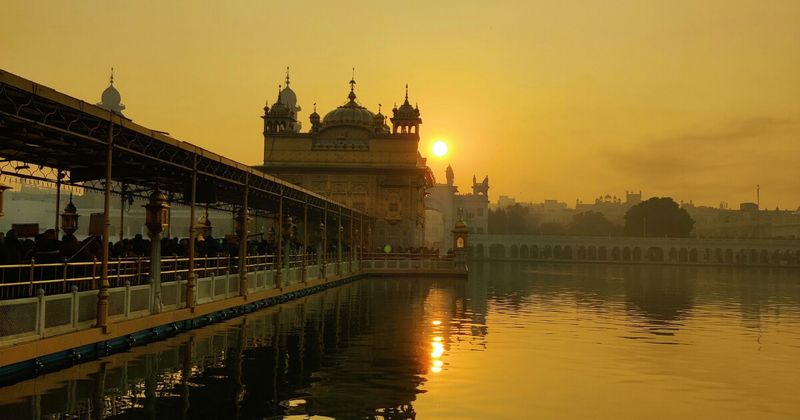
The Golden Temple has been destroyed and rebuilt seven times since its foundation — by Afghan invaders under Ahmad Shah Durrani in 1757 and 1762, who also filled the Amrit Sarovar with the carcasses of cows to desecrate the sacred pool; the Sikh community cleaned the pool, rebuilt the shrine, and resumed worship within months each time; this history of destruction and recommencement is part of what gives the Golden Temple its specific quality of earned resilience.
The Palki Sahib ceremony — the Guru Granth Sahib's sacred procession from its nighttime resting place in the Akal Takht to the central shrine on the golden causeway — takes place before first light, accompanied by the sound of a brass band and the chanting of hundreds of devotees. It is the beginning of the temple's daily cycle. Check the exact time locally; it varies seasonally but typically begins between 3:30am and 5am depending on the time of year.
After the temple: walk the Heritage Street in the morning when the bazaar is setting up — the 1-kilometre restored promenade connecting the Golden Temple's main entrance to the Town Hall houses traditional craft shops, chai vendors, and the Gobindgarh Fort at the western end. The fort was the headquarters of Maharaja Ranjit Singh's artillery corps and is now a museum and cultural complex. Entry: ₹200–500 ($2.13–5.32 USD) depending on the experience. Book through Klook.
Getting to Wagah Border
Depart by 2pm (winter) or 3pm (summer). Wagah is 30 kilometres from Amritsar city centre on the Grand Trunk Road — one of the oldest roads in the Indian subcontinent, running from Kabul to Chittagong, 2,500 kilometres, built and maintained for 2,500 years. It takes approximately 45–60 minutes by auto or hired car depending on traffic.
Transport options: The double-decker tourist bus from the Maharaja Ranjit Singh statue roundabout costs ₹350 ($3.72 USD) roundtrip and drops you near the border entrance — easy and sociable. A private auto-rickshaw costs ₹400–600 ($4.26–6.38 USD) roundtrip. Book a fixed-fare vehicle through Intui.travel — the most convenient option, with a driver who waits during the ceremony and confirms pickup after.
Wagah Border: The Beating Retreat Ceremony
Entry: free. No ticket, no booking, first-come-first-served seating in the grandstand.
Winter timings (October–March): ceremony begins at 4:15pm; arrive at the border security checkpoint by 2:30pm at the latest. Summer timings (April–September): ceremony begins at 5:15pm; arrive by 3:30pm at the latest.
These are hard deadlines. The security process — bag checks (bags of any size are not permitted inside; deposit them at the locker kiosks at ₹50/$0.53 USD per bag), metal detection, ID verification, queuing for the grandstand — takes 30–45 minutes. The grandstand fills completely in the final 60 minutes before the ceremony. If you arrive late, you may watch from standing areas with restricted views.
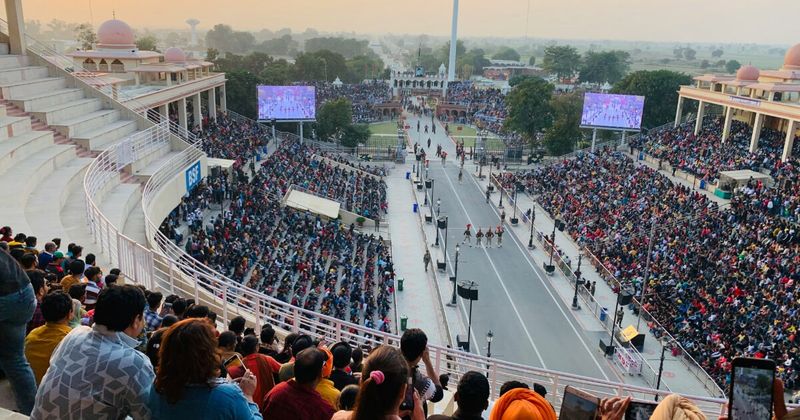
The soldiers selected for the Wagah Border ceremony must be over 6 feet tall and are trained specifically for the high-kick parade routine — the BSF calls the ceremony "Retreat" and describes the objective as a dignified closing of the border; the soldiers themselves describe it differently, as a competition; the Pakistani Rangers introduced ever-taller flagpoles in the early 2000s, India responded with a taller flagpole, Pakistan built a taller one; as of 2026, India's flagpole at Attari is 360 feet tall — making it one of the tallest flagpoles in Asia — a monument to an ongoing infrastructure competition over which country can fly its flag highest at the same border crossing.
What actually happens. The Beating Retreat Ceremony was begun jointly by India and Pakistan in 1959 as a daily closing of the land border — a formal lowering of both countries' flags at sunset, agreed by both governments. What it has evolved into is something considerably more theatrical. The soldiers of India's Border Security Force and Pakistan Rangers have been selected specifically for their height (all are above 6 feet) and trained for years in choreography. The ceremony involves:
Soldiers marching to the gates with exaggerated high kicks — the leg raised perfectly horizontal, the boot driven into the air with force sufficient to suggest genuine aggression, then brought down in a stamp that echoes across the grandstand. The crowd on the Indian side (30,000 on a busy weekend) responds with chanting, flag-waving, and an escalating frenzy that has the quality of a competitive sporting event. The soldiers on the Pakistani side respond with equal force to the Pakistani crowd's responses. The whole thing is essentially a daily competition in nationalist performance art, and it has been running every day since 1959.
At the climax: the gates open. The soldiers from both sides shake hands with studied abruptness. The flags of India and Pakistan are lowered simultaneously, folded with ceremony, and carried back across the line. The gates close. The crowd disperses.
Foreigners in Amritsar: you will be directed to the VIP section — a seated area with a clear sightline, separated from the main Indian grandstand. The Indian side is louder and more participatory (the music is LOUD, people dance, volunteer flag-runners sprint across the ground). The VIP section is excellent for photography. If you want to be in the middle of the crowd energy, arrive very early and join the general seating before the foreigner redirect happens.
Critically: no mobile phones work near the border. Military signal jammers disable all networks. Download offline maps and your hotel's address before you leave Amritsar in the morning. Your driver will not have signal either; agree on a meeting point — a specific café or landmark — before the ceremony begins.
What to Skip in 2 Days
The Golden Temple day-trip add-on options. The Tarn Taran Sahib Gurudwara (27 kilometres south) is one of the most important Sikh shrines in Punjab, with a tank larger than the Golden Temple's. Pul Kanjari is a Maharaja Ranjit Singh-era rest house. Both are excellent. Neither fits meaningfully into a 2-day Amritsar itinerary — the Golden Temple itself requires two visits at different hours to be understood, and adding a third gurudwara risks turning a spiritual experience into a checklist.
The Gobindgarh Fort show. The fort's multimedia historical experience takes 2–3 hours and is best visited if you have a third day. On a 2-day circuit, the Heritage Street walk that passes the fort's exterior provides context without the time investment.
The Durgiana Temple. A Hindu temple built in the same period as the Golden Temple, architecturally mirroring it in many details. Worth 30 minutes if you have time after Jallianwala Bagh — not worth replacing any Day 1 anchor experience for.
Pace and Burnout: The Amritsar Rhythm
Amritsar is a two-day city that operates at a specific pace: very early mornings, one long quiet afternoon, and a late evening ceremony that brings Day 2 to a close. It doesn't suit the compulsive city-sprinters who fill every gap between landmarks with another monument. The Golden Temple specifically requires patience — sitting with the kirtan for 20 minutes that you hadn't planned, joining the langar queue when you'd intended to move on, walking the parikrama a second time because the light changed.
The best seats at Wagah: The left-grandstand section nearest the Indian flag gives you the clearest view of the ceremony sequence without being behind the flag. Arrive 90 minutes before ceremony start to claim these. Women can join the group that runs with the Indian flag across the border approach road before the ceremony — a specific participating tradition that children and women are invited to join; ask the gate stewards.
Punjab in winter: Amritsar in December–January is 3–15°C — genuinely cold by Indian standards, with fog that sometimes delays morning trains from Delhi. Pack a proper jacket. The Golden Temple in fog — the shrine appearing through the mist over the Amrit Sarovar — is one of the more extraordinary weather experiences in India.
Best time to visit: November–February. March has warmth and thinning crowds. Baisakhi (April 13) — the Sikh New Year and the anniversary of Jallianwala Bagh — is both the most crowded and most charged time to visit; the ceremony at Jallianwala Bagh on that specific date is extraordinarily solemn.
Amritsar pairs naturally with Delhi — it's the logical extension of any North India circuit. Our Delhi in 3 Days guide covers the capital comprehensively. Together, Delhi (3 days) + Amritsar (2 days) = 5 days of dense North India historical and spiritual experience without crossing into Rajasthan.
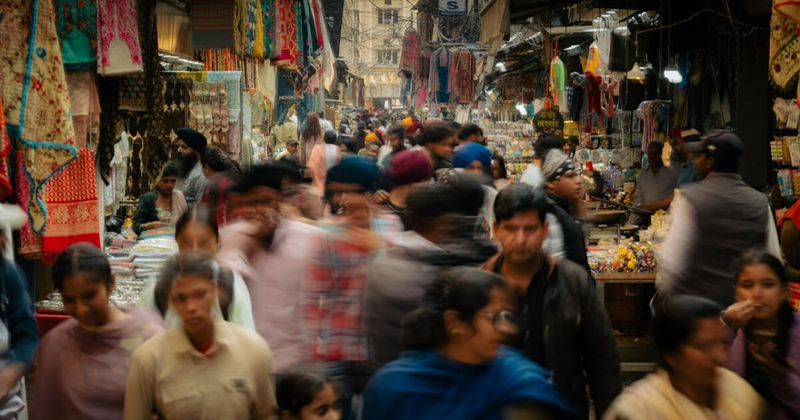
The Heritage Street in Amritsar was developed between 2013 and 2016 as part of an urban regeneration project that restored the 19th-century shopfronts along the route from the Golden Temple to the Town Hall — the same route that Sikh pilgrims have walked for 400 years; the project was controversial because it displaced some existing businesses, but the preservation of the architectural character of the approach to the Golden Temple is widely considered a successful outcome for the city's heritage core.
2-Day Amritsar Budget Breakdown
| Expense | Budget | Mid-Range | Splurge |
|---|---|---|---|
| Train from Delhi (Chair Car, one way) | ₹900 ($9.57) Shatabdi | ₹1,200 ($12.77) Vande Bharat | ₹2,500+ sleeper berth AC |
| Accommodation (2 nights) | ₹800–1,500 ($8.51–15.96)/night near temple | ₹3,000–5,000 ($31.91–53.19)/night | ₹8,000–15,000+ ($85.11–159.57+) heritage |
| Airport/station transfer | ₹80–150 ($0.85–1.60) auto | ₹500–800 GetTransfer/KiwiTaxi | ₹1,500+ |
| Golden Temple | Free | Free | Free |
| Langar | Free | Free | Free |
| Amritsari kulcha breakfast (2 days) | ₹80–160 ($0.85–1.70) | ₹160–300 ($1.70–3.19) | — |
| Kesar da Dhaba dinner | ₹250 ($2.66) per person | ₹250 ($2.66) per person | — |
| Jallianwala Bagh | Free | Free | Free |
| Partition Museum | ₹250 ($2.66) foreigners | ₹250 ($2.66) | — |
| Wagah Border ceremony | Free | Free | Free |
| Wagah vehicle Intui.travel | ₹350 ($3.72) tourist bus | ₹600–1,000 ($6.38–10.64) auto roundtrip | ₹1,500–2,000 ($15.96–21.28) car |
| City autos/transport | ₹300–500 ($3.19–5.32) | ₹500–800 ($5.32–8.51) | — |
| Travel insurance | VisitorsCoverage/EKTA from ~$12 | from ~$12 | from ~$12 |
| 2-day total per person (excl. Delhi train) | ₹5,000–8,000 ($53–$85) | ₹12,000–20,000 ($128–$213) | ₹40,000+ ($426+) |
All prices INR. USD at ₹94 = $1. INR prices reliable; USD approximate.
Check Live Flight Prices
The Bottom Line
Every India itinerary gives Amritsar too little time or skips it entirely in favour of Rajasthan's more cinematic forts and lakes. This is understandable and wrong.
The Golden Temple is not a monument. It does not behave like one. It has no closing time, no entry fee, no audio guide, no gift shop, no roped-off section where the sacred thing is placed at a distance. It is an active, breathing, 24-hour expression of what a community decided it believed about equality and welcome — and it has been that, continuously, for 450 years. Jallianwala Bagh's bullet holes are not behind glass. The Partition Museum's testimony is from people who were alive in 1947 and gave their accounts in the years before they died. The Wagah Border ceremony is simultaneously pompous, absurd, and genuinely moving — two countries performing their rivalry in coordinated high kicks every single evening because in 1959 they agreed that this was better than not speaking at all.
Punjab changes every India trip. Add it.
Your Amritsar Trip Planning Checklist
🛡️ Travel Insurance — First, Always: VisitorsCoverage — Compare plans; minimum $100K USD medical; 2-day Amritsar Punjab policies from ~$12–20 USD; sort before flights and trains | EKTA — Affordable second option from $0.99/day at ektatraveling.com; worldwide digital coverage, 24/7 multilingual support. Compare both and choose.
✈️ Flights & Train Protection: FlyFlick — Search all routes into Amritsar (ATQ) or plan Delhi (DEL) arrival with onward Shatabdi train | Compensair — Claim up to €600 for delayed/cancelled flights; Delhi fog in December–January disrupts both ATQ flights and Delhi-Amritsar trains.
🚂 Train to Amritsar — Book 2–3 Weeks Ahead: 12Go Asia — Book Delhi New Delhi (NDLS) → Amritsar (ASR): Swarna Shatabdi 12029 (departs 7:20am, arrives ~1:30pm, CC from ₹900–₁,200); Vande Bharat fastest at 5.5hrs; include complimentary breakfast. Book return journey at same time.
🚖 Transfers: GetTransfer — Pre-booked fixed-fare transfer from Amritsar railway station or ATQ airport | KiwiTaxi — Confirmed for Amritsar airport and station transfers | Intui.travel — Wagah Border roundtrip fixed-fare vehicle; Day 1 city circuit if preferred over auto.
🎟️ Experiences to Pre-Book: Klook — Partition Museum guided tour (adds essential context; book 24 hours ahead); Gobindgarh Fort experience if adding on Day 2 morning; full Amritsar heritage tour combining temple, Jallianwala, and museum.
📱 Connectivity: Saily — 5G eSIM; excellent in Amritsar city and on train journey from Delhi | Drimsim — Not essential for Amritsar (good domestic coverage) but useful if continuing to Kashmir or Himachal.
Two days. Two ceremonies. One city that changes how you see the rest of India.