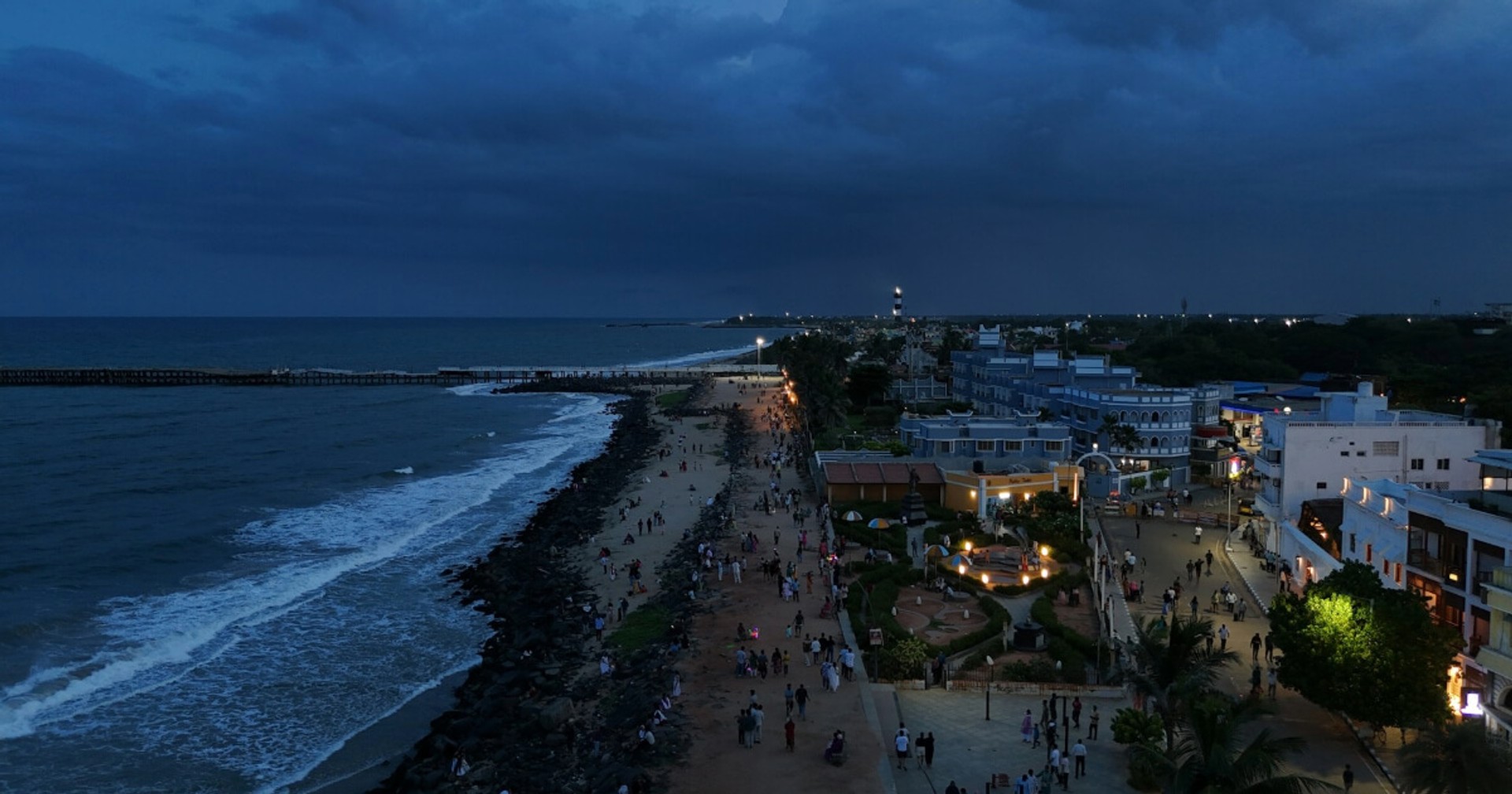

Every South India conversation arrives at Kerala eventually.
The backwaters of Alleppey, the tea estates of Munnar, the spice plantations of Thekkady — Kerala is genuine and it is extraordinary and the internet has photographed all of it from every possible angle and uploaded the results to every platform that accepts photographs. It is, by any measure, one of the most beautiful places in the world, and it is also, at peak season, reliably full of people who have all read the same three blog posts.
Tamil Nadu is sitting immediately to the east with a completely different set of extraordinary things that most of those travellers fly over on their way somewhere else.
The Brihadeeshwara Temple in Thanjavur was completed in 1010 CE by Raja Raja Chola I. The 66-metre Vimana tower — the central shrine tower — was designed by Chola engineers using solar geometry so precise that the tower's shadow falls backward onto the temple itself at noon on every day of the year, and never touches the ground outside the structure. This is a feat of architectural engineering 1,000 years old. The temple is free to enter. It is a UNESCO World Heritage Site. It contains the oldest known detailed accounting records in India — inscribed stone records of the temple's employees, their wages, and their duties, carved into the walls in the 11th century.
The Chettinad mansions of the Nattukotai Chettiar merchant community were built using materials imported from four continents — Belgian crystal chandeliers, Burmese teak pillars, Staffordshire Art Nouveau floor tiles, Italian marble floors — and transported by bullock cart from the Tamil Nadu coast to a landlocked interior district. The community financed infrastructure across British Burma, Malaya, and Ceylon, built towns that would have been recognisable in Europe, and have spent the decades since 1947 selling those towns for their materials. An estimated 60–70% of Chettinad's great mansions will not exist in 20 years. What is still standing is standing now.
Ten days in Tamil Nadu and Pondicherry is the argument that South India is not one thing and that the part most people skip is the part with the most to show.
Sort VisitorsCoverage travel insurance before this trip — the circuit involves temple steps, heat exposure, and long train journeys. Policies from approximately $18–35 USD. EKTA offers a second option from $0.99/day at ektatraveling.com. Compare both before booking.
10-Day Tamil Nadu Circuit at a Glance
| Days | Location | Focus |
|---|---|---|
| 1–2 | Chennai | Marina Beach, Kapaleeshwarar, Mylapore |
| 3 | Mahabalipuram | Shore Temple, Descent of the Ganges |
| 4–5 | Pondicherry | White Town, Auroville, Sri Aurobindo Ashram |
| 6 | Chettinad | Heritage mansions, Chettinad lunch |
| 7–8 | Thanjavur | Brihadeeshwara, Thanjavur Palace, Gangaikonda |
| 9–10 | Madurai | Meenakshi Temple, Thirumalai Nayak Palace |
Why This Route — and Why It's Not Kerala
The standard South India itinerary that most international visitors plan is: fly into Kochi, backwaters → Munnar → Periyar → Madurai → fly home. Tamil Nadu is a tail added to a Kerala trip.
This circuit reverses the logic. Tamil Nadu is the primary. It starts in Chennai — the fourth-largest city in India, almost entirely ignored as a starting point in international travel guides — moves south along the coast, turns inland to Chettinad, and ends in Madurai, which is the oldest continuously inhabited city in South India and one of the most extraordinary temple cities in the world.
The architecture alone justifies the itinerary. Tamil Nadu contains five of the seven UNESCO World Heritage Sites in South India. The Dravidian temple tradition — gopurams (carved gateway towers) covered in thousands of coloured sculptures, corridor temples with pillared halls that extend for hundreds of metres, living temples with tens of thousands of daily worshippers — reaches its highest expression in Tamil Nadu and does not exist in this form anywhere in Kerala.
The food is different. The language is different. The cultural logic is different. Tamil Nadu is not a version of Kerala. It is a completely separate South India.
Fly into Chennai International Airport (MAA) — direct connections from London (9hrs), Singapore (4hrs), Dubai (3hrs 30min), Kuala Lumpur, and multiple European hubs. Search and book on FlyFlick. Set a Compensair alert — MAA handles heavy traffic and EU-connected return legs from Chennai carry full €600 delay compensation eligibility.
Book your MAA arrival transfer through GetTransfer or KiwiTaxi — both confirmed for Chennai airport routes. Activate Saily 5G eSIM before landing — excellent coverage across Chennai, Pondicherry, and Thanjavur. Drimsim covers the Chettinad interior roads where single-carrier SIMs occasionally drop.
Days 1–2: Chennai — The City Most India Guides Skip Entirely
Chennai receives a paragraph in most South India guides and a day at most in 10-day itineraries. It deserves two days and the reasons are specific.
Chennai is the cultural capital of Tamil Nadu — the city where classical Carnatic music and Bharatanatyam dance are performed to the highest standards in the world every December during the Margazhi Music Season (roughly December 15–January 15), where the largest film industry in South India operates, and where Mylapore — one of the oldest continuously inhabited urban neighbourhoods in India — contains a concentration of temple architecture, silk shops, filter coffee houses, and street food traditions that no other South Indian city replicates.
Day 1: Marina Beach and Mylapore. Marina Beach — 13 kilometres of urban beach running south from Fort St. George — is the second-longest urban beach in the world (Praia do Cassino in Brazil is longer by a few kilometres). Free. The morning on Marina Beach: the beach at 6am before the heat, the fishing boats coming in from the overnight catch, the specific smell of salt and jasmine and diesel that defines Chennai. Walk south to Mylapore (3 kilometres, walkable or auto-rickshaw ₹80–120/$0.85–1.28 USD). The Kapaleeshwarar Temple at Mylapore is a 7th-century Dravidian temple in active daily use — the morning puja at 9am, the gopuram tower rising 37 metres above the tank, the peacocks that live in the temple courtyard and for whom the temple is named (Kapali = peacock, Ishwara = Lord Shiva). Free entry. Remove shoes; cover shoulders and knees.
Day 2: Fort St. George, Egmore Museum. Fort St. George (1640 CE, the oldest surviving British fortification in India, free entry) — the original seat of the East India Company in Madras, where Clive of India and Elihu Yale (the Yale University benefactor) both served. The fort museum contains the oldest surviving documents of British India and the actual flag of the East India Company. Government Museum Egmore (₹250 foreigners, $2.66 USD) — the second-oldest museum in India (1851), containing the finest collection of Chola bronze sculpture in the world. The Nataraja bronze collection alone — the dancing Shiva sculptures that became the most internationally recognised symbol of South Indian art — is worth an hour of slow looking.
Filter coffee. The Chennai filter coffee — made in a two-stage metal tumbler-and-davara set, strong roasted coffee decoction with hot milk and sugar — is the best version of coffee in India and is available at every Saravana Bhavan or Murugan Idli shop for ₹20–30 ($0.21–0.32 USD).
Book a Day 2 city circuit through Intui.travel. Chennai's traffic makes pre-booked fixed-fare vehicles significantly less stressful than individual auto negotiations.
Accommodation Chennai: Budget ₹1,000–2,000 ($10.64–21.28 USD); midrange near Mylapore ₹3,500–7,000 ($37.23–74.47 USD).
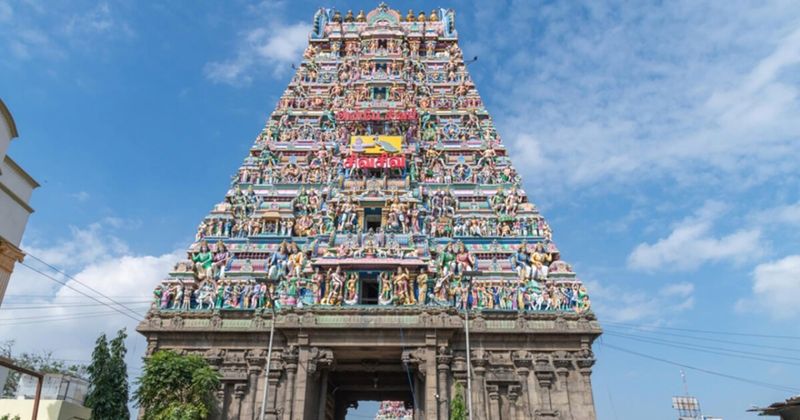
Kapaleeshwarar is dedicated to Shiva as the Lord of the Peacock — the temple was demolished by the Portuguese in the 16th century and rebuilt by the Vijayanagara Empire in 1670 on a new site 400m from the original.
Day 3: Mahabalipuram — Where the Ocean Came for the Temples
Chennai to Mahabalipuram: 60 kilometres south on the East Coast Road (ECR). Shared bus from Chennai Mofussil Bus Terminus: ₹50–70 ($0.53–0.74 USD), 2 hours. Private vehicle through Intui.travel: ₹2,000–3,500 ($21.28–37.23 USD) fixed fare, the most practical option if combining with the Pondicherry onward the same day.
Mahabalipuram (officially Mamallapuram) is a UNESCO World Heritage Site — a 7th–8th century Pallava-dynasty coastal town where the entire landscape is a monument complex. The Shore Temple, the Five Rathas, and the Descent of the Ganges relief are the three anchor sites.
Shore Temple (₹600 foreigners, $6.38 USD): Open 6am–6pm. Built in the early 8th century under Pallava king Narasimhavarman II — two structural Shiva shrines and one Vishnu shrine combined in a single seawall complex, the granite blocks darkened by 1,300 years of sea spray. The specific quality of the Shore Temple at 6:30am: the first light catching the carved tower, the sound of the Bay of Bengal behind the seawall, the salt in the air. Most day-trippers from Chennai arrive after 9am. Be there before them.
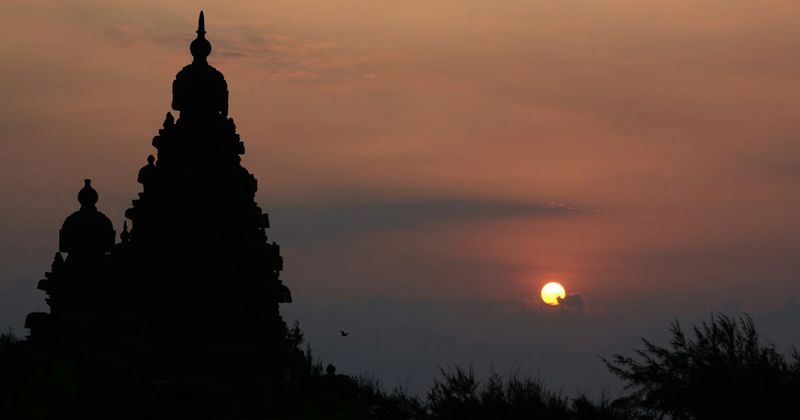
The Shore Temple has stood in the Bay of Bengal's salt spray since the 8th century; marine archaeological surveys found submerged temple structures offshore, suggesting a larger complex consumed by the sea over 1,300 years.
Descent of the Ganges (Arjuna's Penance): Free. The largest bas-relief in the world — a 27-metre long by 9-metre tall carved granite face depicting the descent of the Ganges from the heavens, with natural rock cleavage used as the river itself, hundreds of carved figures (elephants, gods, sages, nagas, animals) surrounding it. Every figure is different. Every animal is anatomically accurate. The composition is resolved at a scale that modern architectural drawings couldn't improve on. A cleft in the rock runs vertically through the centre — during the monsoon, water channelled from above flowed down this cleft as the depicted Ganges, completing the composition with actual water. The mechanism still works.
Five Rathas: ₹600 (combined ticket with Shore Temple, $6.38 USD). Five monolithic temples carved from single granite boulders in the 7th century — each in a different architectural style, each named for a Pandava hero from the Mahabharata. The Dharmaraja Ratha, the largest, is 12 metres high and was carved from a single boulder over what must have been decades. Pre-book both Shore Temple and Five Rathas through Klook.
"Flying into Chennai to start this Tamil Nadu circuit? Search all MAA routes below."
Check Live Flight Prices
Days 4–5: Pondicherry — The French Quarter and the Experimental City
Mahabalipuram to Pondicherry: 95 kilometres south on the ECR. Bus: ₹80–100 ($0.85–1.06 USD), 2.5 hours. Private vehicle through KiwiTaxi: ₹2,500–4,000 ($26.60–42.55 USD) fixed fare — covers the coastal road without the bus-station complications.
Pondicherry (officially Puducherry since 2006, though the old name persists universally) was a French colonial territory from 1674 until 1954 — 280 years of French administration producing an urban fabric unlike anywhere else in India: grid-planned streets, yellow and ochre heritage buildings with shuttered windows and wrought-iron balconies, French street names still in use (Rue Romain Rolland, Rue Suffren), Catholic churches with trilingual masses (French, Tamil, English), and croissant bakeries operating since before Indian independence.
White Town: The French Quarter, bounded by the sea to the east and the canal to the west. The canal — dug by the French in the 18th century as a deliberate social and physical boundary between the French colonial settlement and the Tamil Indian neighbourhood — still runs through the city. White Town is to the east of the canal: the heritage buildings, the cafés, the Maison Perumal and Villa Shanti hotels. The Tamil Quarter is to the west: the functioning Dravidian temples, the flower markets, the real filter coffee at half the price. Both are worth walking. The canal is worth understanding as what it actually is — a physical inscription of colonial social hierarchy that the city has absorbed rather than erased.
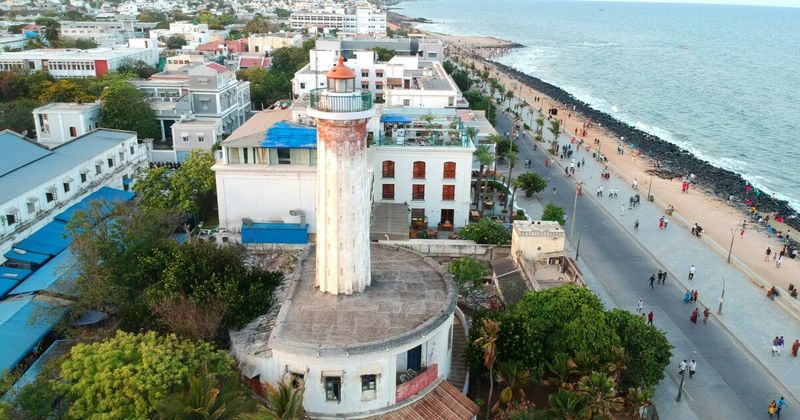
Pondicherry was French colonial territory from 1674 to 1954 — 280 years longer than most Indian territories. French is still spoken here and French street names remain in official use.
Sri Aurobindo Ashram: Free. Founded in 1926 by the philosopher-yogi Sri Aurobindo and the French-born spiritual figure Mirra Alfassa (known as "The Mother"), the ashram at Rue de la Marine contains both their samadhis (tombs) and a still-functioning community of practitioners. The atmosphere inside the main building — the flowers on the samadhi, the silence — is entirely different from a temple. No shoes. No photography. 8am–12pm and 2pm–6pm.
Auroville: the process matters. Auroville is not a tourist attraction — it is an intentional community of approximately 3,500 people from 60+ countries living on 20 square kilometres of land north of Pondicherry around a collective vision of human unity. The Matrimandir — the gold-sphere meditation centre at Auroville's geographic centre — requires advance registration at the Visitors Centre (free). Exterior viewpoint: ₹50 ($0.53 USD), walk-in basis, 9am–4pm. The inner meditation chamber requires a separate application made several days ahead through the Visitors Centre website; it is not bookable same-day and most visitors don't make it inside. The exterior approach — through a gravel path under the tree canopy, the gold sphere emerging through the forest — is available to all registered visitors and is architecturally extraordinary.
Pondicherry food: The French Quarter cafés (Café des Arts, Baker Street, Surguru) serve genuine croissants, filter coffee, and eggs Benedict in colonial courtyard settings. Mains ₹250–600 ($2.66–6.38 USD). The Tamil Quarter has the honest local food — dosas, idli, sambar, filter coffee — at half the price. Satsanga on Labourdonnais Street serves the best fusion of both at midrange prices. Le Café on the seafront promenade is open 24 hours and serves cold coffee on the rocks while looking at the Bay of Bengal.
Accommodation: Budget guesthouses in Tamil Quarter from ₹800–2,000 ($8.51–21.28 USD); heritage boutique hotels in White Town from ₹4,000–16,000 ($42.55–170.21 USD). Book White Town properties 3–4 weeks ahead in October–February — good rooms sell within days of opening.
Day 6: Chettinad — The Mansions Being Sold for Parts
Pondicherry to Chettinad: 215 kilometres southwest. By car through Intui.travel: 3.5–4 hours, ₹5,000–7,000 ($53.19–74.47 USD) for the fixed-fare vehicle — Chettinad lacks convenient public transport and requires a private vehicle for the mansion circuit. Train to Karaikudi (nearest Chettinad town) from Villupuram Junction: approximately 3 hours, from ₹150 Sleeper ($1.60 USD) on 12Go Asia.
The context most guides omit:
The Nattukotai Chettiars — the Chettiar merchant community of Tamil Nadu's Sivaganga district — were among the wealthiest merchants in British colonial South Asia by the late 19th century. They financed infrastructure, rubber plantations, and rice mills across British Burma, Malaya, Fiji, and Ceylon. The profits came home to their landlocked birthplace in an interior Tamil Nadu district with no industry, no railway until late, and no natural resources. And they spent it on the most elaborate domestic architecture in South Asia.
The materials: Italian marble for the floors. Belgian crystal chandeliers imported through Madras. Burmese teak columns, used because it is one of the hardest woods in the world. Staffordshire Art Nouveau encaustic tiles — the distinctive geometric floor tiles manufactured in England specifically for export to India. Bavarian clock towers. Venetian glasswork. All transported by bullock cart from the coast to the interior, a journey of several days.
The mansions were built for two purposes: to demonstrate wealth during the wedding season when the Chettiar men returned from overseas, and to house their families in their absence. The communities around which they were built — Karaikudi, Devakottai, Kanadukathan — are not tourist infrastructure. They are real towns with real economies, and the mansions exist in them as monuments to a commercial culture that lasted approximately 80 years and is still being dismantled.
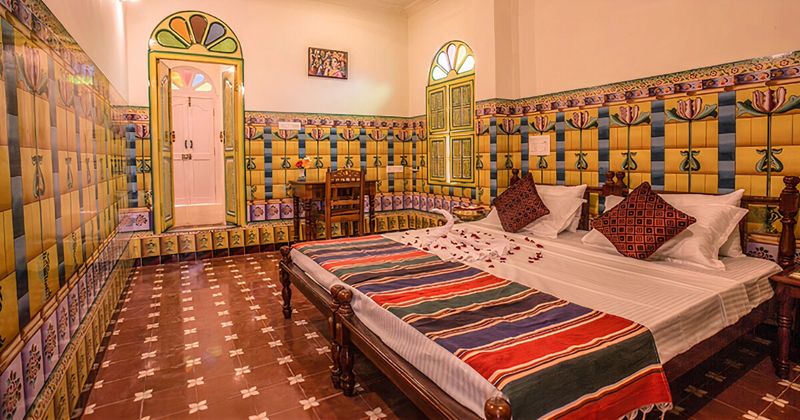
The Chettinad mansions' imported materials were transported by bullock cart from the Tamil Nadu coast. An estimated 60–70% of surviving mansions will be sold for materials within 20 years.
What to do: Book a guided heritage mansion walk through Klook (₹200–500/$2.13–5.32 USD per person). The guides are local residents — some are family members of the original owners — who explain the provenance of each material and the social context of the construction. The walk covers 3–4 accessible mansions in 2 hours. Kanadukathan village — 15 kilometres from Karaikudi — is the best-preserved Chettinad settlement and has several mansions in various states of inhabitation and decay.
Chettinad lunch: The cuisine is Tamil Nadu's most internationally recognised culinary tradition — Chettinad chicken (slow-cooked with a specific paste of fresh ground pepper, kalpasi, marathi mokku, and stone flower that has no equivalent in any other regional cuisine), Kuzhi Paniyaram (fermented rice dumplings), and Kavuni Arisi (black rice pudding). A full Chettinad meal at a heritage dining hall: ₹200–400 ($2.13–4.26 USD) per person. The meal cooked by Chettiar families in heritage homes is categorically different from "Chettinad curry" in any restaurant anywhere else in the world. Eat it here.
Days 7–8: Thanjavur — The Temple Whose Shadow Knows the Sun
Chettinad to Thanjavur: 90 kilometres northwest, 1.5–2 hours by vehicle. Continue the Intui.travel vehicle from Day 6 for the Karaikudi–Thanjavur leg, or take a local bus from Karaikudi to Thanjavur (₹60–80/$0.64–0.85 USD, 2 hours).
Thanjavur (Tanjore) was the capital of the Chola Empire at its height in the 10th–11th centuries — an empire that extended from Tamil Nadu across Southeast Asia to Cambodia, Malaysia, and Indonesia, whose navy controlled the Indian Ocean trade routes, and whose court patronised classical music, bronze sculpture, and temple architecture to a standard that no subsequent South Indian dynasty matched.
Brihadeeshwara Temple (Brihadeeswara / Big Temple): 6am. Free entry. Open 6am–12:30pm and 4pm–8:30pm. UNESCO World Heritage Site. Photography allowed outside the sanctum; not inside the main shrine.
The Vimana — the central shrine tower — is 66 metres high and built entirely of granite. The engineering fact that no competitor guide mentions: the tower was designed using Chola solar geometry so that at solar noon on every day of the year, the tower's shadow falls backward onto the temple complex itself and never touches the ground outside the structure. This is not coincidental. The Chola astronomers specifically calibrated the tower's taper and the site's geographic orientation to achieve this effect. The calculation requires knowing the exact latitude, the sun's declination on every day of the year, and the relationship between tower height, base width, and shadow length. They had all of this. In 1010 CE.
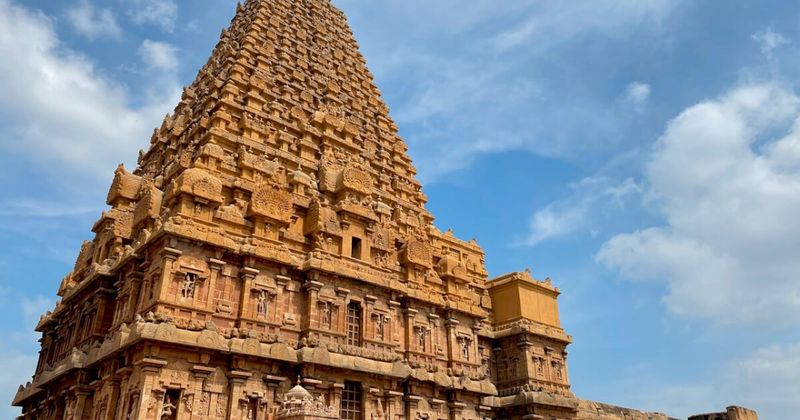
The Brihadeeshwara Vimana was completed in 1010 CE and remains the tallest temple tower in Tamil Nadu. Its shadow geometry — falling inward at solar noon on every day of the year — was deliberately engineered by Chola astronomers.
The Nandi bull at the entrance — carved from a single piece of granite, 3.7 metres high, one of the largest Nandis in India — guards a Shiva linga inside the main sanctum. The stone records inscribed on the inner walls by Raja Raja Chola I are the oldest detailed employee records in India — the names of temple staff, their duties, their wages, the quantities of temple provisions — a 1,000-year-old payroll inscribed in stone.
Thanjavur Palace: Day 8 morning. Entry ₹25 ($0.27 USD), closed Fridays. The palace complex of the successive Nayaka and Maratha rulers of Thanjavur — built and expanded over 400 years, containing the Saraswati Mahal Library (200,000 manuscripts in Tamil, Sanskrit, Telugu, Marathi, and European languages — including palm-leaf manuscripts and European-printed books dating from 1535), the royal Durbar Hall, and the Art Gallery (₹30/$0.32 USD) housing the finest collection of Chola bronze sculpture outside the Government Museum in Chennai. The Thanjavur paintings (a local tradition combining gold leaf, precious stones, and mineral colours on a gesso base) are available in the market streets surrounding the palace from ₹2,000–15,000+ ($21.28–159.57+ USD).
Gangaikonda Cholapuram: 70 kilometres from Thanjavur — a half-day trip. The second "Great Living Chola Temple" (UNESCO) — built in 1035 by Rajendra Chola I to celebrate his military campaigns north to the Ganges, and larger than Brihadeeshwara by some measurements. Almost entirely unvisited by international tourists. Free entry. Book a vehicle through Intui.travel for the Thanjavur–Gangaikonda day trip.
Accommodation Thanjavur: Budget from ₹800–1,500 ($8.51–15.96 USD); midrange from ₹2,500–5,000 ($26.60–53.19 USD).
Days 9–10: Madurai — The City That Has Been Alive for 2,500 Years
Thanjavur to Madurai: 170 kilometres southwest, 3–3.5 hours by road or train. The Cholan Express (12683) departs Thanjavur approximately 12:30pm, arrives Madurai Junction approximately 15:50 — 3 hours 20 minutes, CC from ₹320 ($3.40 USD). Book on 12Go Asia — 2–3 weeks ahead for peak season.
Madurai is one of the oldest continuously inhabited cities in South India — the Sangam-era Tamil literature places it as a major city in the 3rd century BCE, and there is no period since for which it has not been a functioning urban centre. It is currently a city of 1.5 million people and the site of the most visited temple in Tamil Nadu.
Meenakshi Amman Temple: dawn and dusk. The temple operates in two sessions: 5am–12:30pm and 4pm–10pm. Entry: free general admission. Foreigners' special darshan: ₹50 ($0.53 USD) per person per shrine — separate tickets for the Meenakshi and Sundareshwarar shrines; combined ₹100 ($1.06 USD). Non-Hindus are not permitted into the inner sanctums. This fact appears nowhere in competitor guides. Plan for the outer corridors, the Hall of a Thousand Pillars (985 pillars, each differently carved), the Golden Lotus Tank, and the 14 gopurams — the outer tower visible from anywhere in Madurai, covered in 33,000 painted sculptures depicting the full Saivite cosmological world.
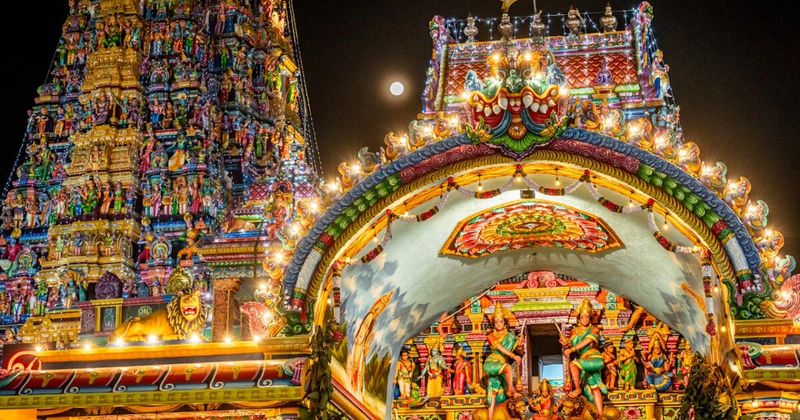
The gopuram sculptures are repainted entirely every 12 years by a team of traditional artists working for approximately 3 years — what appears to be ancient colour is in fact continuously renewed.
The detail no guide explains: the sculptures on the gopurams are repainted entirely every 12 years — every figure, every colour, every panel — in a repainting programme that employs dozens of craftspeople for approximately 3 years. What you're looking at is a living artwork in constant regeneration, not a preserved relic. The colour is intentional, not decorative. Each figure's specific colour identifies their status in the Saivite cosmological hierarchy. Pre-book the guided temple tour through Klook — a Tamil-speaking guide translates the iconography that the visual experience otherwise makes opaque.
The Madurai Jigarthanda. No food experience in Tamil Nadu is more specifically local. Jigarthanda is a cold drink — milk reduced with nannari (Indian sarsaparilla root syrup) and almond gum, topped with a thick layer of rich cream, served in a glass with ice — sold only in Madurai, at shops that have been making it for generations. It is not available outside Madurai with the same preparation. Jigarthanda Original on East Avani Moola Street is the most celebrated address; ₹80–150 ($0.85–1.60 USD) per glass. Order two. You will want two.
Thirumalai Nayak Palace: Day 10 morning. Entry ₹100 foreigners ($1.06 USD), open 9am–1pm and 2pm–5pm. Built in 1636 by King Thirumalai Nayak — an Indo-Saracenic structure mixing Dravidian and Islamic architectural elements, with a Durbar Hall of massive stucco columns 12 metres high that could seat 10,000. The son of the king later sold most of the palace's carved material to repair the Meenakshi Temple — the result is a building that is extraordinary in what remains and more extraordinary in understanding what was removed.
Koodal Azhagar Temple and surrounding lanes: The second major temple in Madurai — Vishnu (as opposed to Meenakshi's Shiva) — is 500 metres from the Meenakshi Temple and consistently empty of tourists. Free. The surrounding flower market (open from 4am, wind down by 8am) supplies the garlands for both temples and is one of the most sensory markets in Tamil Nadu.
Accommodation Madurai: Budget near the temple ₹800–1,500 ($8.51–15.96 USD); midrange from ₹2,500–5,000 ($26.60–53.19 USD).
Getting Around Tamil Nadu: The Transport Logic
Tamil Nadu's circuit requires combining trains (for the long intercity legs) with private vehicles (for the day trips to Gangaikonda, Chettinad, and Mahabalipuram). The combination is cheaper and more flexible than a single hired driver for the full 10 days.
Train legs worth booking:
- Chennai Egmore → Villupuram (for Pondicherry connection): 2.5hrs, from ₹100 ($1.06 USD) — book on 12Go Asia
- Karaikudi → Thanjavur: 2hrs, from ₹150 ($1.60 USD)
- Thanjavur → Madurai Cholan Express: 3hrs 20min, CC ₹320 ($3.40 USD)
- Madurai → Chennai (return): 7hrs overnight, Sleeper ₹250 ($2.66 USD) / 3AC ₹700 ($7.45 USD)
Vehicle days: Mahabalipuram day trip (from Chennai or en-route to Pondicherry), Chettinad circuit, Gangaikonda Cholapuram from Thanjavur. Book all through Intui.travel.
City transport: Madurai, Chennai, and Pondicherry all have functional auto-rickshaw networks. Ola and Uber operate in Chennai and Madurai. Download apps before arrival — the metered auto is increasingly rare and negotiated fares require confidence.
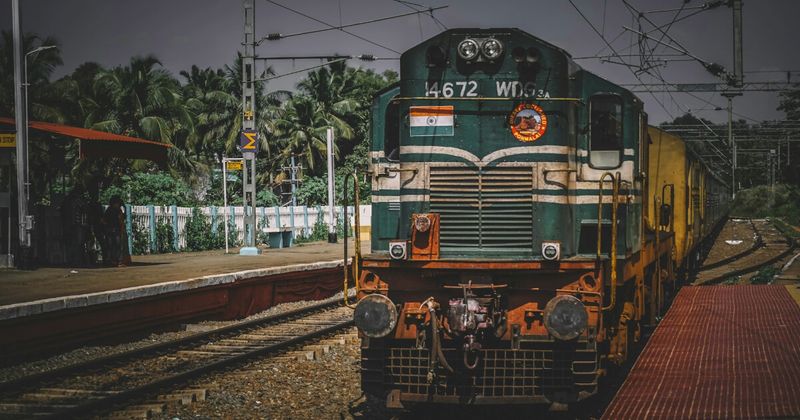
Tamil Nadu's train network connects all major circuit cities; the Chennai–Madurai overnight train crosses the full breadth of the state, from the Bay of Bengal coast to the Vaigai River plains.
What to Skip in 10 Days
Ooty and the Nilgiri hills. The hill station 250 kilometres northwest of Thanjavur is beautiful — the Nilgiri Mountain Railway (UNESCO), tea estates, cooler air. It requires adding 2 days and disrupts the circuit's south-facing momentum. The Nilgiri Mountain Railway is covered in our India by Train guide as a standalone.
Rameswaram and Kanyakumari. The southernmost circuit extension — adding the Ramanathaswamy Temple at Rameswaram and the cape at Kanyakumari adds 2–3 days and 400+ kilometres. Both are extraordinary. Both deserve a separate trip rather than being compressed into the final days of an already-full circuit.
Multiple Pondicherry beaches. The beaches at Serenity Beach and Paradise Beach are good. They are not the reason to be in Pondicherry. Use the beach time for the White Town lanes, the Auroville Visitors Centre, and the canal at 6pm. The beach can be any beach. The French Quarter canal cannot.
Trichy (Tiruchirappalli) as a standalone stop. The Sri Ranganathaswamy Temple on Srirangam island — the world's largest functioning Hindu temple complex by area — is genuinely extraordinary. It fits as a half-day extension from Thanjavur (40km). It does not warrant a separate night on this 10-day circuit; absorb it as a Day 7 morning before Brihadeeshwara.
Pace, Heat and the Tamil Nadu Rhythm
Tamil Nadu's specific travel challenge is heat. The state sits between 8° and 13° north latitude — the sun is close to vertical for most of the year, the humidity is significant on the coast, and the combination of temple stone floors (burning in the afternoon), outdoor monument sites, and walking distances produces a fatigue that most visitors from temperate climates underestimate.
The correct daily structure in Tamil Nadu:
Temples and outdoor monuments before 10am — all the major sites open at 6am and the first 3 hours are the best 3 hours. Covered spaces or air-conditioned hotels 12pm–3pm. Late afternoon visits (3pm–sunset) for palaces, gardens, and markets. Evenings for temple evening puja — the Meenakshi evening ceremony (the procession carrying Lord Sundareshwarar to Meenakshi's shrine) begins at approximately 9pm and is the most theatrical temple ritual in Tamil Nadu.
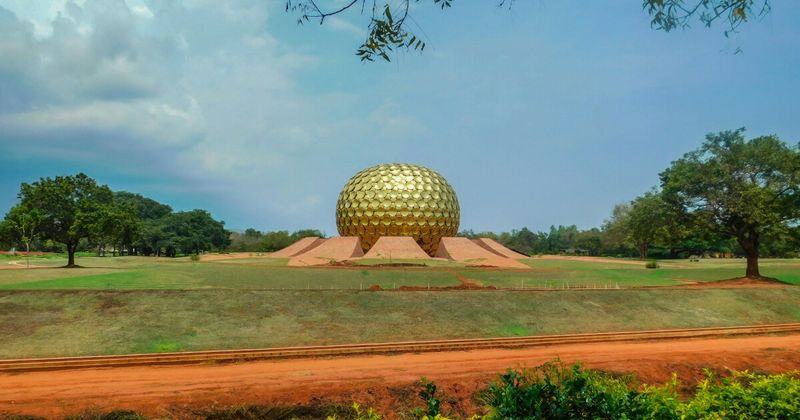
Auroville houses 3,500 residents from 60+ countries in a self-governed intentional community. The Matrimandir inner meditation chamber is not bookable same-day — apply through the Visitors Centre website several days ahead.
Best season: October–March. November and December are the coolest, clearest months across the inland circuit (Chennai and Pondicherry receive the northeast monsoon in October–December but this is manageable short-wave rainfall rather than the monsoon deluge of the southwest). January–March is excellent across all sites. April–June is extreme heat; avoid.
For connecting Tamil Nadu with South India's western side, our Kerala in 7 Days guide is the natural continuation — Madurai has direct trains to Kochi (4.5 hours) making a 17-day combined Tamil Nadu + Kerala circuit entirely feasible.
10-Day Tamil Nadu Budget Breakdown
| Expense | Budget | Mid-Range |
|---|---|---|
| International flights into MAA | Search FlyFlick | varies |
| MAA airport transfer | ₹400–600 ($4.26–6.38) auto | ₹1,500–2,500 GetTransfer/KiwiTaxi |
| Accommodation (10 nights avg) | ₹800–2,000 ($8.51–21.28)/night | ₹3,500–7,000 ($37.23–74.47)/night |
| Chennai city vehicle Intui.travel | — | ₹2,000–3,500 ($21.28–37.23) |
| Mahabalipuram Shore Temple + 5 Rathas | ₹600 ($6.38) | ₹600 + Klook guide |
| Mahabalipuram/Pondicherry vehicle | ₹80–100 ($0.85–1.06) bus | ₹2,500–4,000 KiwiTaxi car |
| Auroville Matrimandir viewpoint | ₹50 ($0.53) | ₹50 |
| Chettinad vehicle + heritage walk | ₹5,000–7,000 ($53.19–74.47) + ₹200 guide | same |
| Thanjavur → Madurai Cholan Express | ₹320 ($3.40) CC | ₹700–1,000 ($7.45–10.64) |
| Brihadeeshwara Temple | Free | Free |
| Thanjavur Palace + Art Gallery | ₹55 ($0.59) combined | ₹55 |
| Gangaikonda Cholapuram day trip | Free + vehicle ₹1,500 ($15.96) | same |
| Meenakshi Temple Madurai | Free general | ₹100 ($1.06) combined special darshan |
| Thirumalai Nayak Palace | ₹100 ($1.06) | ₹100 |
| Madurai → Chennai return overnight | ₹250 ($2.66) Sleeper | ₹700 ($7.45) 3AC |
| Food (10 days) | ₹300–500 ($3.19–5.32)/day | ₹800–1,500 ($8.51–15.96)/day |
| Travel insurance | VisitorsCoverage/EKTA from ~$18 | from ~$18 |
| 10-day total per person (excl. int'l flights) | ₹25,000–₄0,000 ($266–$426) | ₹65,000–1,00,000 ($691–$1,064) |
All prices INR. USD at ₹94 = $1. INR prices reliable; USD approximate.
"Flying into Chennai or planning an open-jaw exit from Madurai or Trichy? Search all routes here."
Check Live Flight Prices
The Bottom Line
Tamil Nadu does not need to be explained in terms of what it isn't. It is not a lesser Kerala, not a default South India, not the obligatory temple circuit before the backwaters. It is a state with the oldest continuously inhabited cities in South India, the most ambitious temple architecture in the world, a merchant community that built mansions from four continents' materials and is selling them for parts, a French colonial town with a deliberate social-boundary canal still running through it, and a cold drink in Madurai that has been made the same way since 1879.
Ten days. The circuit goes from the Bay of Bengal coast to the Chola heartland to the city that has been alive for 2,500 years. Kerala will still be there when you come back.
Your Tamil Nadu Trip Planning Checklist
🛡️ Insurance: VisitorsCoverage — Get minimum $100K USD cover before booking anything; Tamil Nadu temple circuit from ~$18–35 USD. | EKTA — Compare at ektatraveling.com from $0.99/day.
✈️ Flights: FlyFlick — Fly into Chennai (MAA); open-jaw out of Madurai (IXM) or Trichy (TRZ) to avoid backtracking. | Compensair — Set delay alert on all EU-connected MAA departure legs.
🚂 Trains: 12Go Asia — Book Thanjavur → Madurai Cholan Express CC ₹320 and Madurai → Chennai overnight Sleeper ₹250 at least 2–3 weeks ahead.
🚖 Transfers and Vehicles: GetTransfer — Pre-book MAA airport arrival. | KiwiTaxi — Chennai airport + Mahabalipuram–Pondicherry coastal transfer. | Intui.travel — Chennai city Day 2 circuit; Chettinad full-day vehicle; Gangaikonda Cholapuram day trip from Thanjavur.
🎟️ Experiences: Klook — Shore Temple + Five Rathas Mahabalipuram ₹600; guided Meenakshi Temple tour; Chettinad heritage mansion walk ₹200–500; Government Museum Chennai ₹250.
📱 Connectivity: Saily — 5G eSIM across Chennai, Pondicherry, Thanjavur, Madurai. | Drimsim — Off-grid backup for Chettinad interior roads and Gangaikonda rural area.
Coast, colony, empire, desert, city. Tamil Nadu in ten days.